Table of Contents
Mid-Century Modern Interior Design:
The Complete Guide
From post-war optimism to the living rooms of today — everything you need to understand, identify, and authentically bring mid-century modern design into your home.
What Is Mid-Century Modern Interior Design?
Walk into a room with a teak credenza hugging the wall, an Eames lounge chair angled toward a window, and sunlight across the terrazzo floor — and you'll understand immediately why mid-century modern interior design never really went out of style. It has the rare quality of feeling both of its time and perpetually ahead of it.
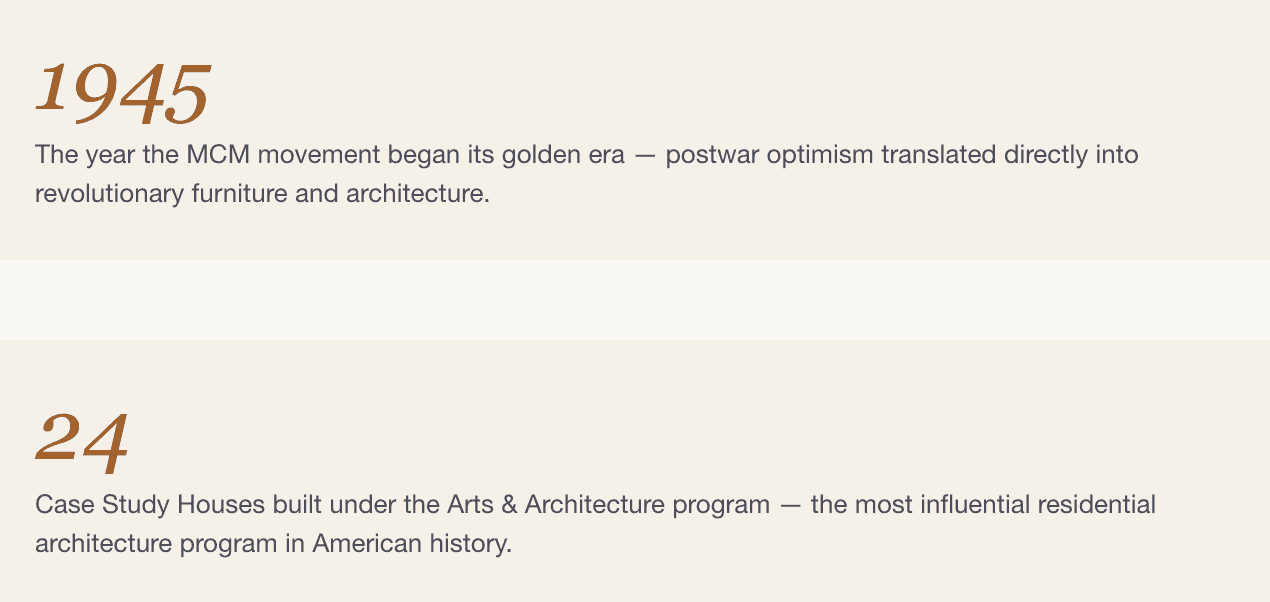
Mid-century modern interior design refers to the movement that flourished roughly between 1945 and 1969, a postwar period defined by radical optimism, new materials, and an urgent belief that good design could improve everyday life. The term itself is broad enough to embrace American ranch houses and Scandinavian apartments, Californian case study homes and New York loft furniture — yet specific enough that you recognize it the moment you see it.
Today, mid-century modern remains one of the most searched, collected, and emulated design movements in the world. On forums like mid-century modern Reddit communities, enthusiasts debate the finer points of Danish provenance and original upholstery. In showrooms, like Hobbs Modern, collectors seek out authenticated vintage pieces — objects that carry the weight of genuine craft and design history. Understanding what mid-century modern actually is, and why it matters, is the first step toward building a home that genuinely reflects the movement rather than merely referencing it.
A Brief History: Where the Style Comes From
The roots of mid-century modern design run deeper than the postwar boom. They stretch back to the early twentieth century and the revolutionary pedagogy of the Bauhaus school in Germany, founded in 1919. The Bauhaus — led by thinkers like Walter Gropius and Marcel Breuer — dissolved the traditional boundaries between fine art and functional craft. Good design, the school insisted, was honest design: form following function, materials used truthfully, ornament stripped away in favor of clarity.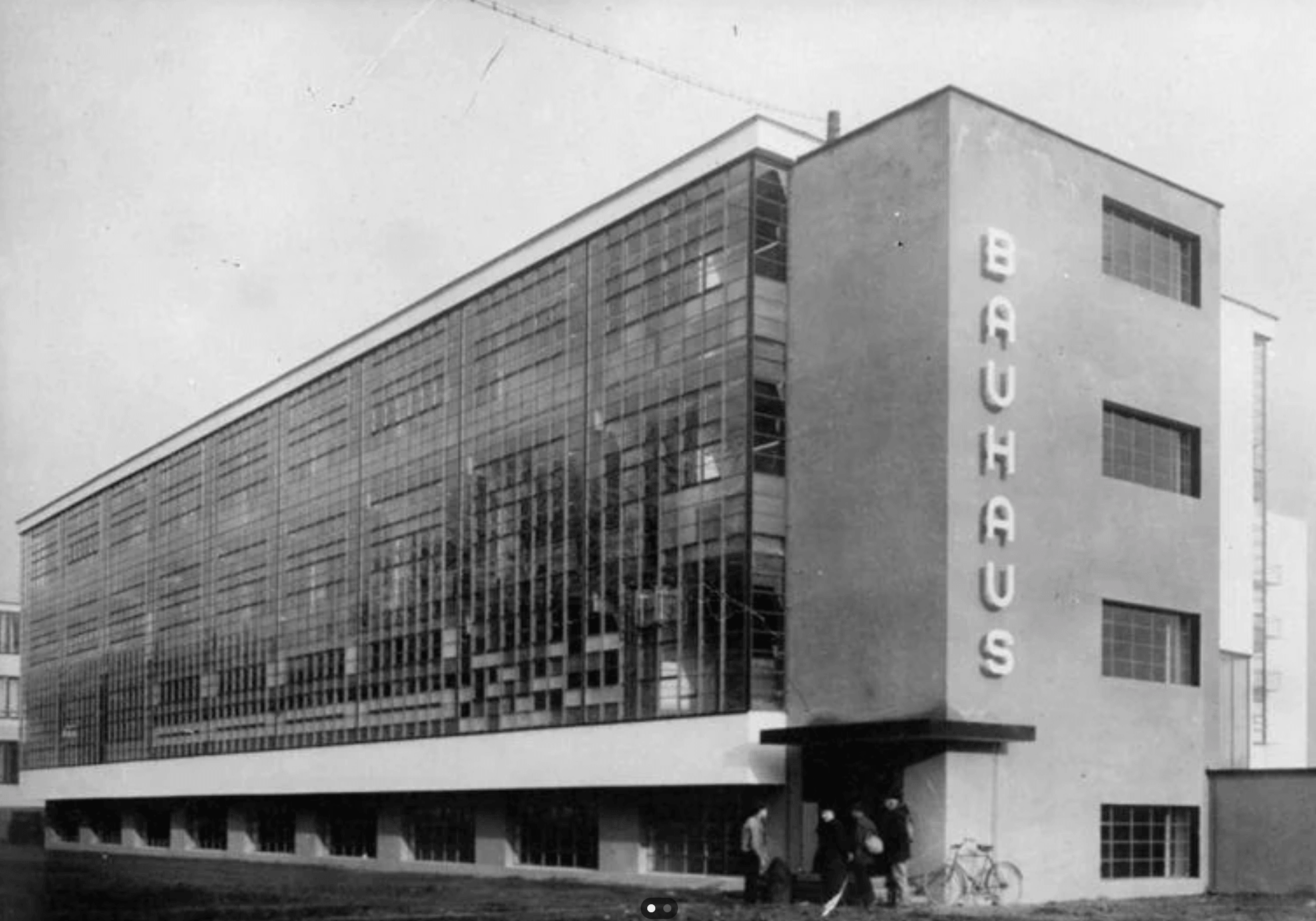
The Bauhaus building in Dessau, Germany (1925–26), designed by Walter Gropius. Its radical fusion of art, craft, and industry shaped the entire MCM movement.
When the Nazis shuttered the Bauhaus in 1933, many of its architects, designers, and teachers emigrated to the United States and Scandinavia — carrying Modernist ideas directly into American and Nordic design culture. This diaspora of talent seeded what would become the golden age of mid-century modern furniture and mid-century modern architecture.
The postwar years supercharged everything. American GIs returned home, suburbs expanded, and a new consumer class needed furniture for a new kind of life. Manufacturers like Herman Miller and Knoll partnered with designers who had been experimenting with wartime materials — molded plywood, fiberglass, aluminum — and applied those techniques to domestic objects. In Scandinavia, designers like Hans Wegner, Arne Jacobson, and Finn Juhl brought their own humanist, craft-rooted sensibility to the movement, producing furniture that was at once warm and modern.
Famous mid-century modern architecture emerged simultaneously on both continents. The California Case Study House Program, sponsored by Arts & Architecture magazine from 1945 to 1966, produced a series of experimental homes that defined the mid-century modern house aesthetic: flat or shed roofs, post-and-beam construction, floor-to-ceiling glass, and a seamless relationship between indoors and outdoors. Architects like Richard Neutra, Pierre Koenig, and Charles and Ray Eames shaped this visual language, and their houses remain among the most photographed examples of mid-century modern house design in the world.
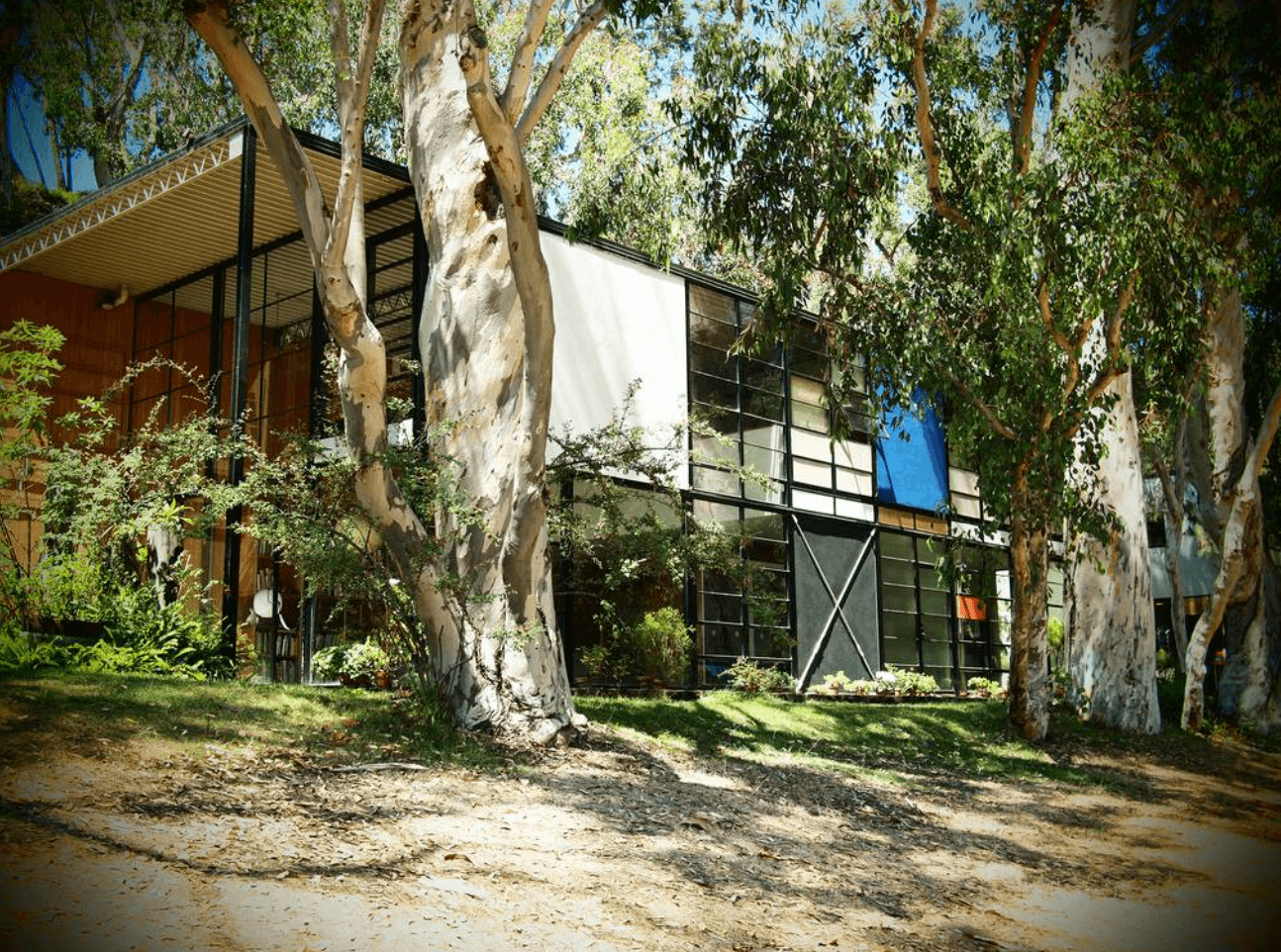
The Eames House, Case Study House No. 8, Pacific Palisades (1949). Charles and Ray Eames designed their home and studio as a seamless integration of post-and-beam structure, glass, and landscape.
Core Characteristics of Mid-Century Modern Design
What distinguishes mid-century modern from other interior design styles? The movement has a set of visual and philosophical traits that are consistent across its many expressions — whether you're looking at a Danish teak dining set, a California ranch home exterior, or a molded fiberglass side chair. Understanding these mid-century modern architecture characteristics and interior design principles is essential for both recognizing authentic pieces and applying the aesthetic meaningfully in your own space.
Clean, unadorned lines balanced with organic, nature-inspired curves. Neither rigidly geometric nor freely fluid.
Every object must earn its place through utility. Beauty and practicality are not in opposition — they reinforce each other.
Teak, walnut, rosewood, leather, molded plywood, fiberglass, and aluminum
Open floor plans, minimal walls, and a deep connection between interior and exterior. Inside outside living. Light and lighting treated as a design material.
Warm neutrals anchored by saturated accent colors: avocado, mustard, burnt orange, teal, and chocolate brown.
Restraint over accumulation. Each piece is chosen deliberately. Negative space is as important as what fills it.
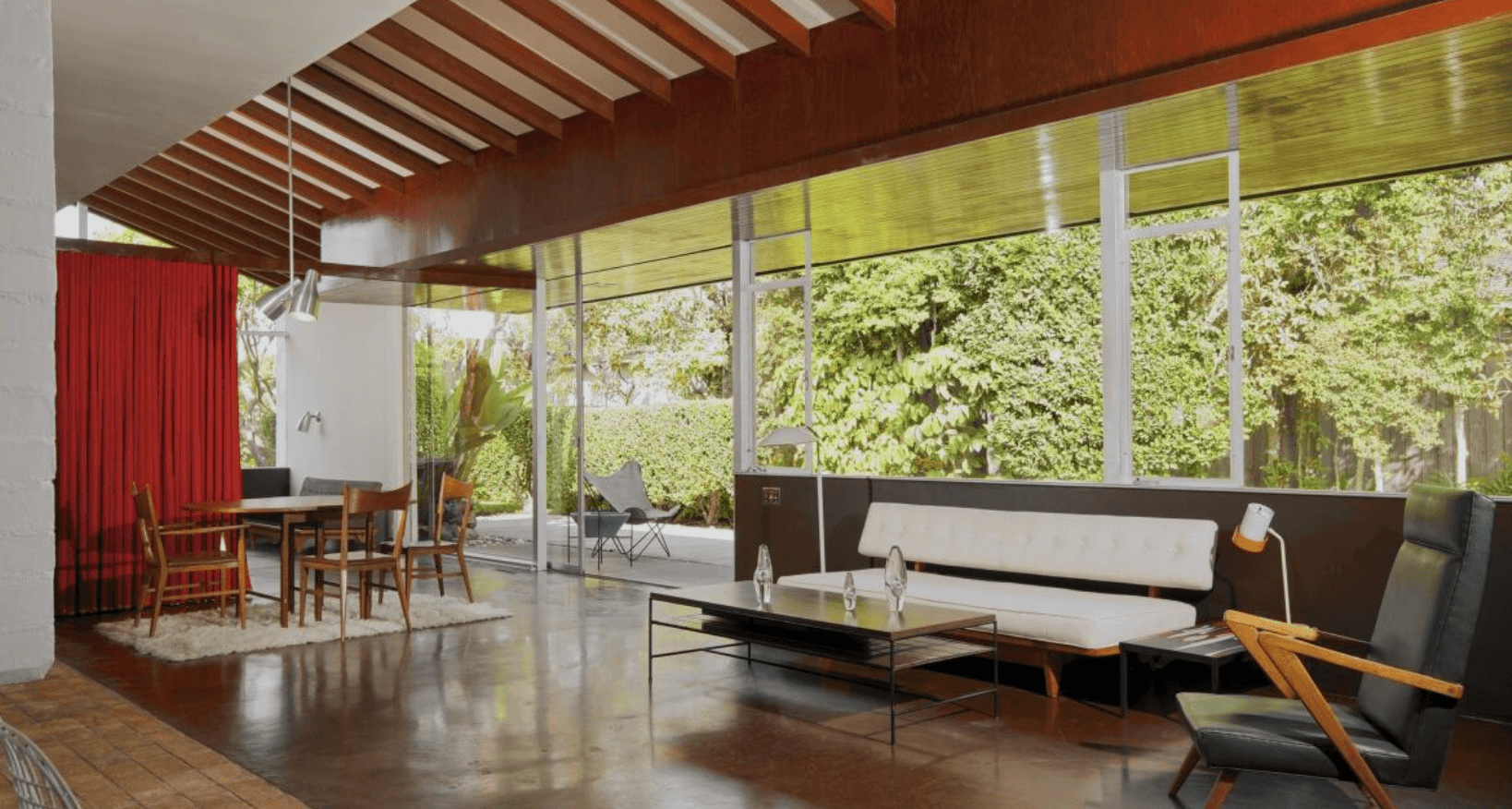
Clean Lines and Organic Forms
One of the defining tensions — and delights — of mid-century modern interior design is the dialogue between geometric precision and natural curve. Furniture legs taper at deliberate angles. Tabletops are crisp rectangles or oval ellipses. And then a chair back sweeps upward in a shape borrowed from a tulip or a wishbone, softening the grid without abandoning it.
This balance is not accidental. It reflects a philosophical conviction among mid-century designers that nature and technology were not opposed forces but complementary ones. The organic forms in a Wegner wishbone chair or the compound curves of an Eames shell chair are the result of deep structural thinking — each curve exists because it distributes weight, follows the body's contour, or responds to the grain of the wood. These are mid-century modern interior design characteristics that feel instinctively right precisely because they are engineered to be so.
In spatial terms, this principle extends to floor plans. Mid-century modern house interiors favor open layouts where rooms flow into one another, delineated by changes in material or level rather than walls. Furniture arrangements are purposeful, often organized around a focal point — a fireplace, a picture window, or a piece of art — rather than pushed to the perimeter.
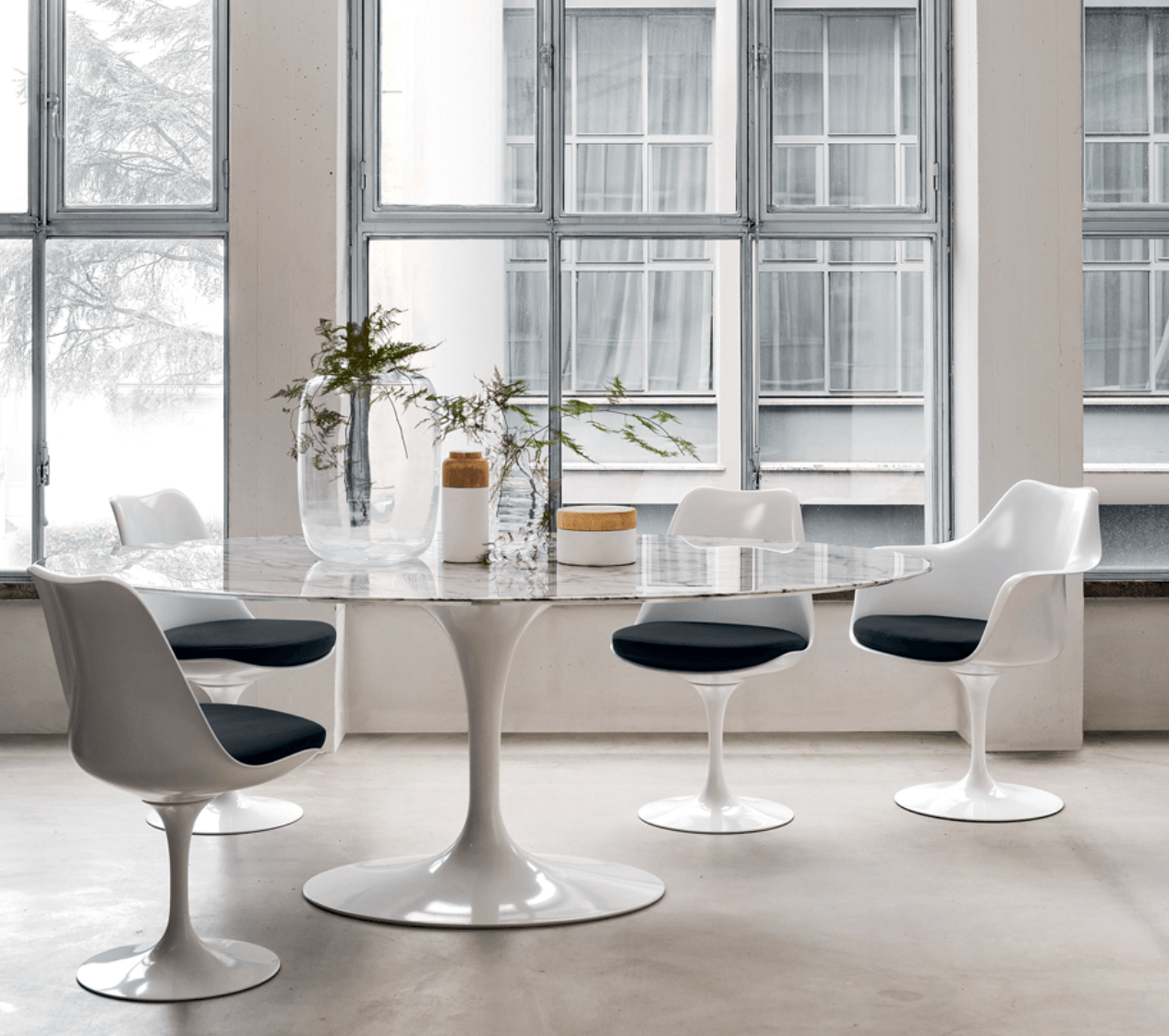
Eero Saarinen's Tulip Chair (1955–56) for Knoll — a definitive example of mid-century modern organic form. The seamless pedestal eliminated visual clutter and gave the chair its iconic, sculptural profile.
Function Meets Beauty
The mid-century modern commitment to functional beauty was, in many ways, a moral position. Designers of the era were responding to a world recovering from war, a world in which millions of new households needed furniture that was affordable, durable, and well-made. The challenge — taken up joyfully by designers like Charles and Ray Eames, George Nelson, and Eero Saarinen — was to make industrial production yield objects of genuine aesthetic quality.
The results were objects that have proven remarkably resilient across seven decades. A well-made Danish teak credenza from 1962 is, in most respects, more functional than a flat-pack equivalent manufactured today. The joinery is tighter, the wood thicker and denser, the hardware more precisely machined. This is why mid-century modern interior design ideas consistently return to authentic vintage pieces as anchors rather than accessories — they are not merely decorative references to the past, but working objects built to outlast generations.
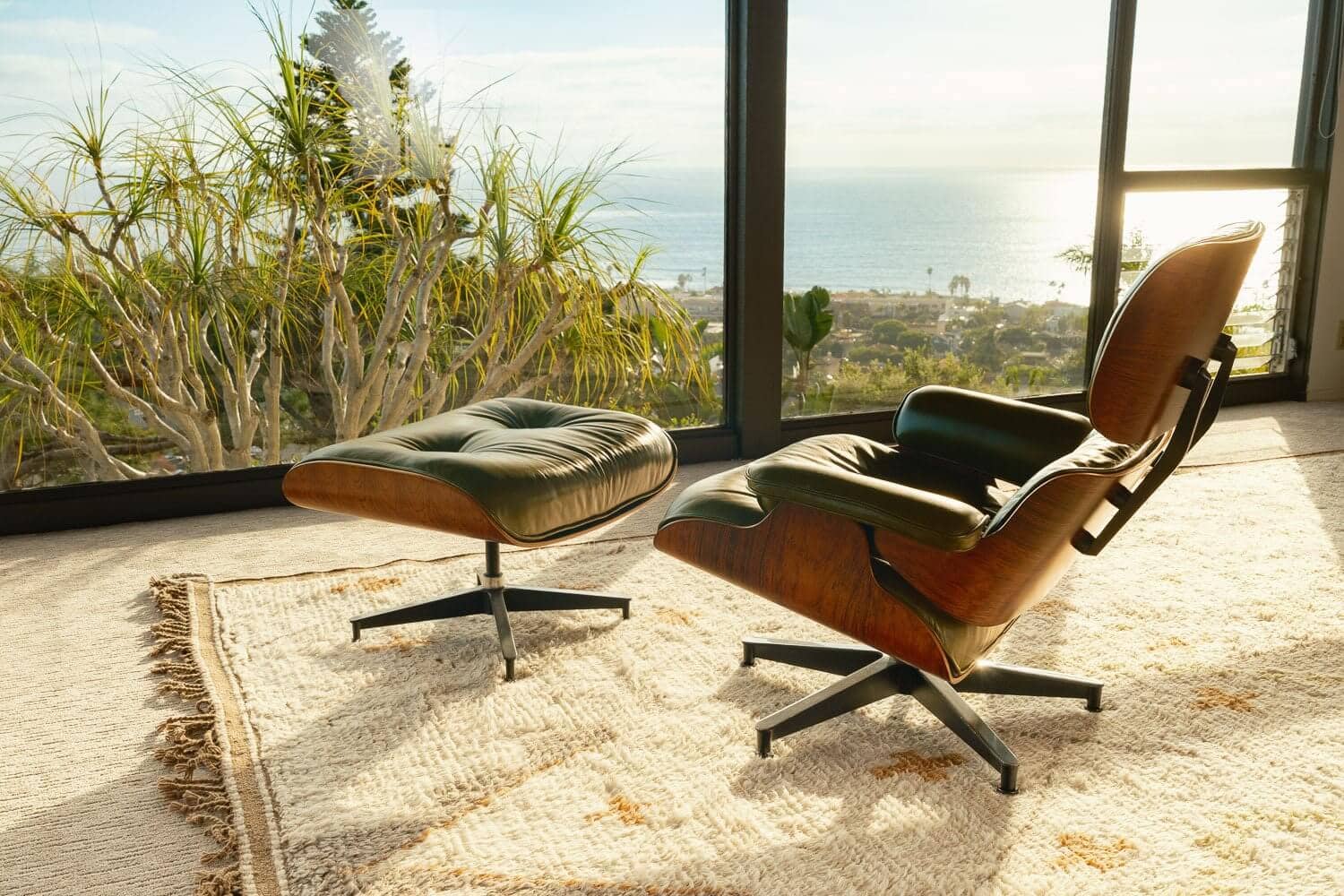
Eames Lounge Chair 670, 1956 (Herman Miller). Molded plywood and leather — industrial materials transformed into domestic luxury.
Natural and Manufactured Materials
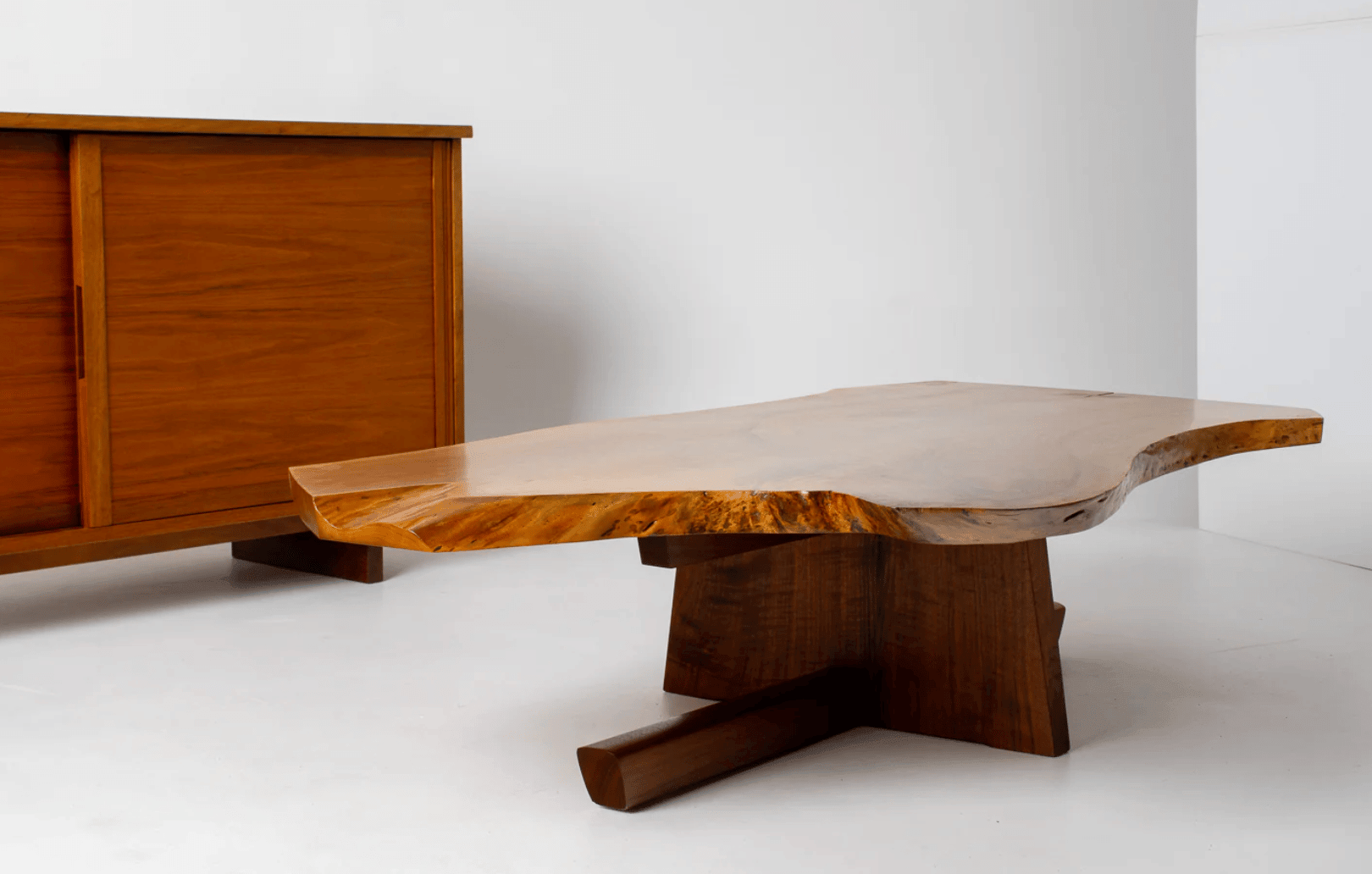
The material palette of mid-century modern design is one of its most immediately recognizable qualities. Warm, rich hardwoods — teak, walnut, rosewood, and oak — form the backbone of nearly every authentic MCM interior. These woods were valued not only for their beauty but for their workability: they carved, bent, and joined in ways that allowed designers to realize complex forms that cheaper materials could not achieve.
Alongside these natural materials, mid-century designers embraced the manufactured materials that postwar industry had made newly available. Molded plywood, pioneered by Charles and Ray Eames during World War II for military leg splints, became the material of the DCW and DCM chairs. Fiberglass allowed Eero Saarinen to realize the seamless, pedestal forms of his Tulip collection. Aluminum enabled the lightweight, stackable structures of Arne Jacobsen Series 7 chairs.
Set of 4 Arne Jacobsen for Fritz Hansen Series 7 Chairs in Rosewood Model 3107

$4,495.00
A masterclass in Danish modern design, this set of four Model 3107 “Series 7” chairs by Arne Jacobsen for Fritz Hansen represents one of the most iconic and enduring chair designs of the 20th century. Originally introduced in 1955, the… read more
In an authentic mid-century modern interior, these materials are never disguised. The grain of the teak is celebrated. The molded form of a fiberglass chair is left in its natural color or a single saturated tone. The leather on a lounge chair ages and patinas deliberately, becoming more beautiful with use. This material honesty — an insistence that things look like what they are — is one of the most enduring mid-century modern interior design characteristics and one of the surest ways to distinguish authentic vintage pieces from modern reproductions.
Iconic Furniture Pieces That Define the Style
No guide to mid-century modern interior design would be complete without an account of the furniture pieces that gave the movement its defining visual language. These are the objects that collectors search for, that appear in mid-century modern architecture books, and that set the tone for entire rooms when placed with care.
- 01Eames Lounge Chair & Ottoman (1956) — Charles & Ray Eames Perhaps the single most recognizable piece of twentieth-century furniture design. Molded plywood shells upholstered in leather, mounted on a cast aluminum swivel base. Originally produced by Herman Miller, it remains in production today — though original examples are prized for their thinner plywood profiles, Rosewood Shells, down feather and supple leather.
- 02Wegner's Wishbone Chair / Y-Chair (1949) — Hans J. Wegner A masterpiece of Danish craft, woven with a paper cord seat and named for the distinctive Y-shaped back rail. Produced continuously by Carl Hansen & Søn since its introduction, the Wishbone Chair is the rare piece that holds its design integrity equally well in an original and a contemporary example.
- 03Arne Jacobsen Egg Chair (1958) Conceived for the lobby of Copenhagen's SAS Royal Hotel, the Egg Chair is Jacobsen's most iconic gift to the canon of mid-century modern seating. Its enveloping, asymmetric shell — sculpted from fiberglass and foam, then upholstered in a single continuous sweep of fabric or leather — was revolutionary at the time and remains visually arresting today. Mounted on a discreet cast aluminum swivel base, the chair seems to float, turning its occupant inward in a quiet pocket of space. Original Fritz Hansen examples, particularly those in period leather color ways, are among the most coveted pieces in serious Scandinavian MCM collections.
How to Achieve the Mid-Century Modern Look in Your Home
Whether you're approaching a mid-century modern interior design living room, a mid-century modern interior design bedroom, or a dining space, the principles are consistent: intentionality over accumulation, quality over quantity, and a willingness to let individual pieces breathe. Mid-century modern is not a maximalist aesthetic — it rewards restraint.
Start with the fundamentals. Keep walls neutral: warm whites, soft grays, or a saturated accent wall in mustard, terra cotta, or deep teal. Let the floor breathe — hardwood or concrete, with a low-pile or flat-weave rug defining the seating area. Window treatments, if any, should be simple: linen sheers or clean roller blinds that preserve the connection to natural light.
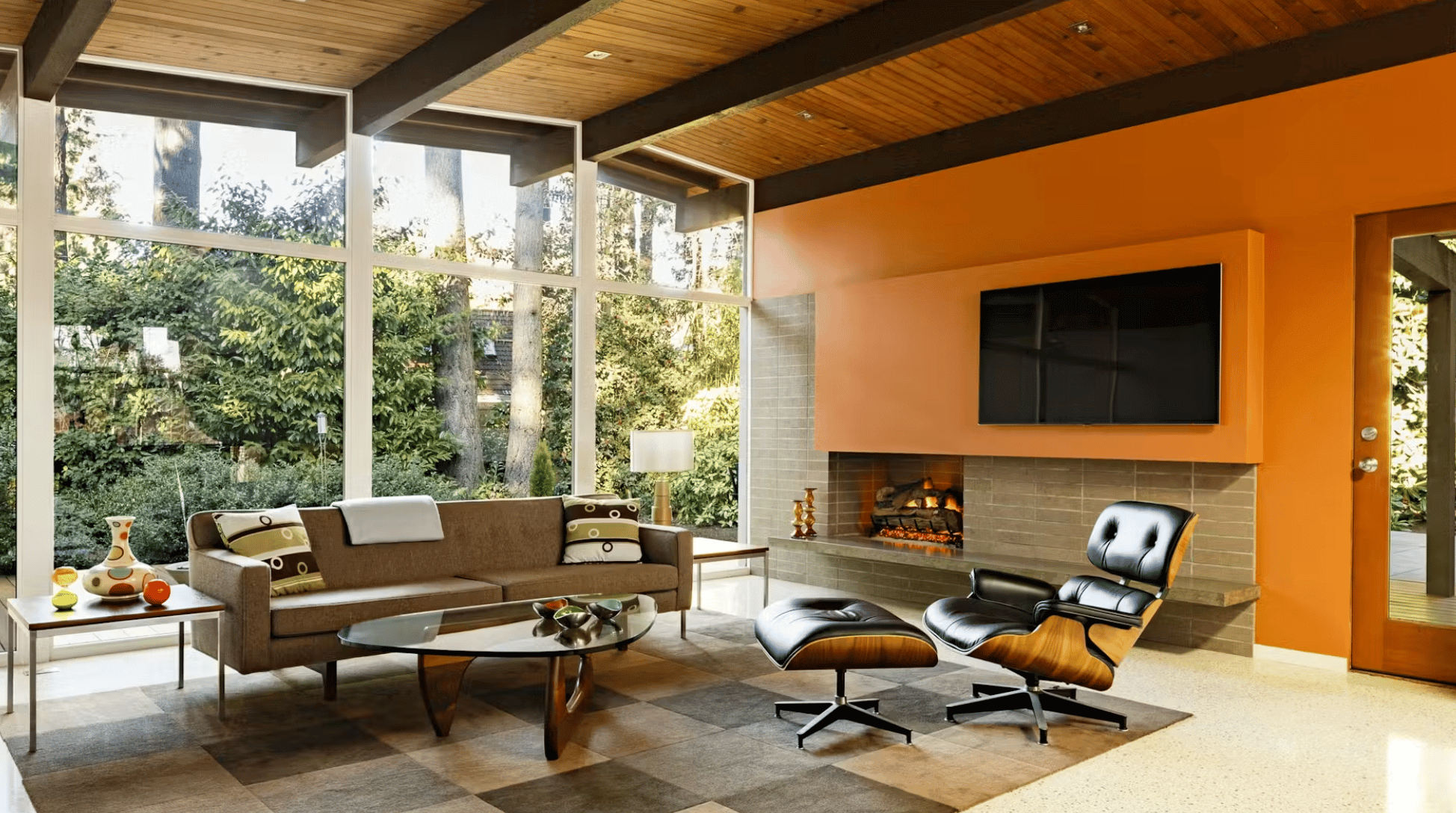
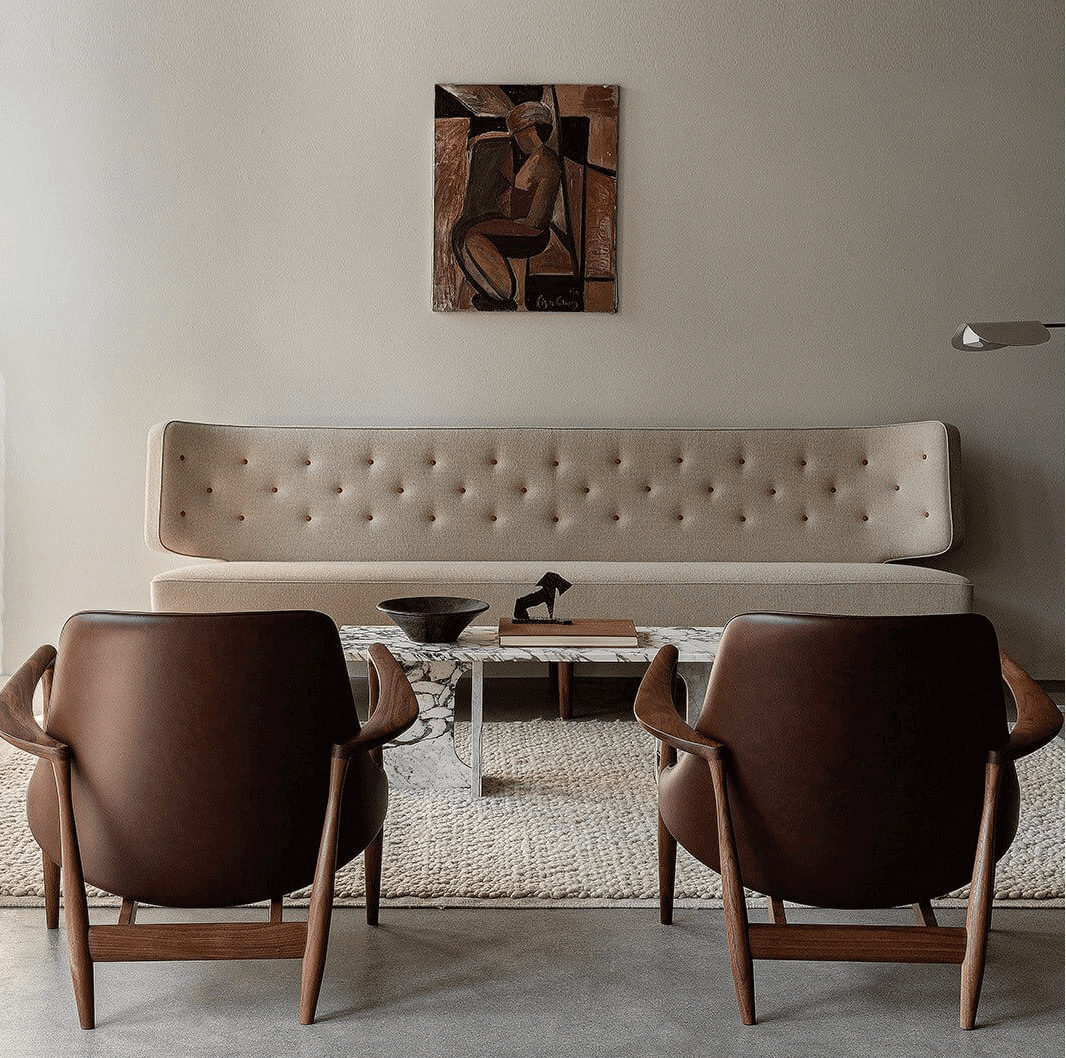
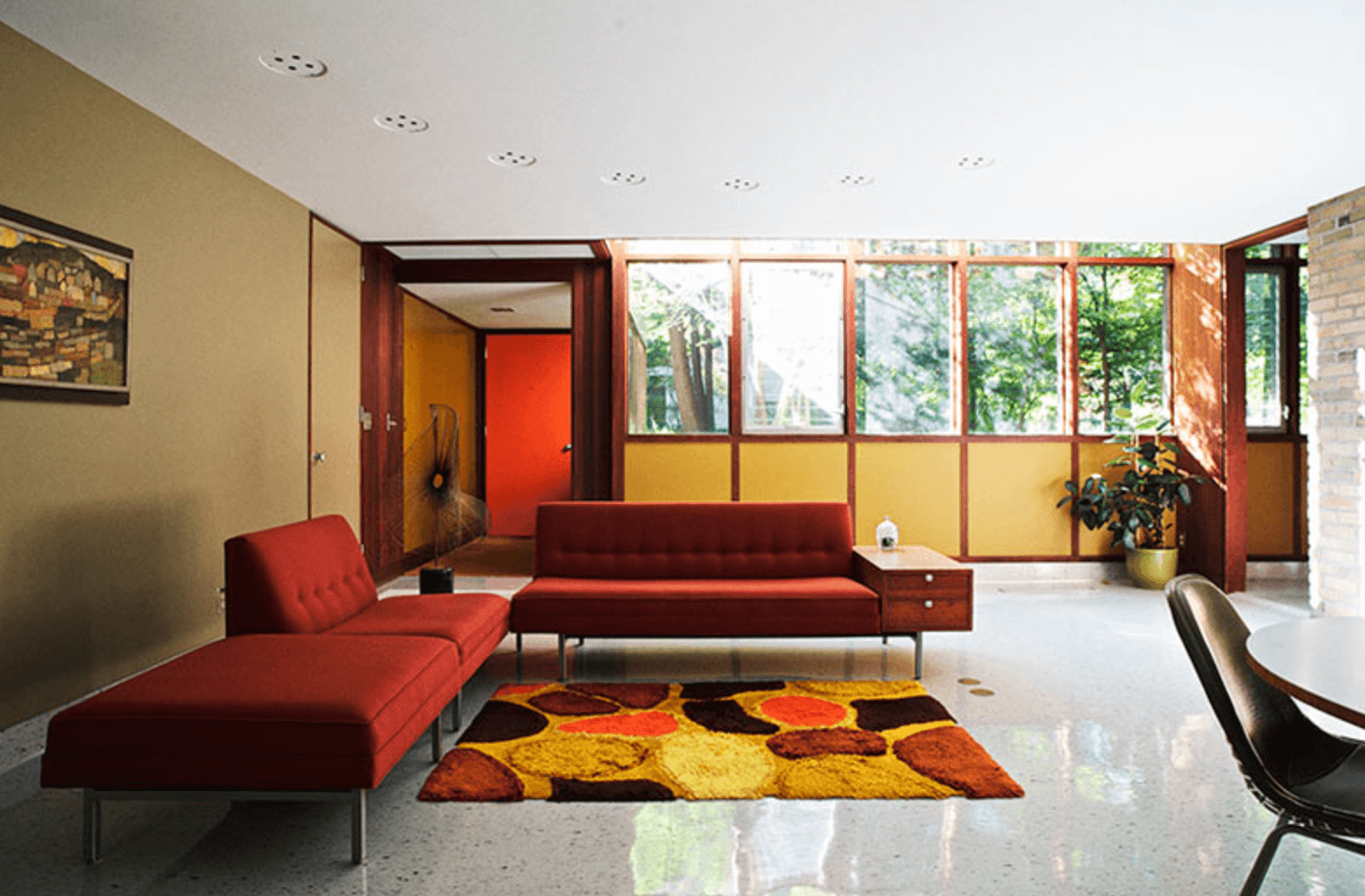
Mid Century Modern living room interior — warm wood tones, low-slung seating, and a picture window bringing the landscape inside. Every element earns its place.
Avoid the common pitfall of filling a space with too many MCM-adjacent objects at once. A room where every surface holds a ceramic ashtray, a pottery lamp, and a lava rock — however authentic each individual piece may be — begins to feel like a museum diorama rather than a home. Edit ruthlessly.
When styling a mid-century modern interior, apply the rule of three: anchor with one large piece (a credenza, a sofa, a dining table), complement with one medium piece (a lounge chair, a floor lamp, a sculptural side table), and accent with one small piece (a ceramic, a piece of art, a sculptural object). More than three competing focal points and the room loses its sense of intention.
Start With One Statement Piece
The most reliable path into a mid-century modern interior is through a single, exceptional piece of authenticated vintage furniture. Not a set — a single piece. One teak credenza. One Eames-era lounge chair. One sculptural Danish dining table. Let that piece set the visual and material tone for everything around it.
This approach works because great mid-century modern furniture is inherently confident. It doesn't need to be surrounded by other mid-century objects to read correctly — it will hold its own in a room that mixes contemporary neutrals, natural textiles, and minimalist lighting. In fact, the contrast between a well-chosen vintage piece and a contemporary backdrop often makes both look better.
A statement piece also gives you time. Building a curated interior is not a weekend project — it's a process of acquisition and editing over months or years. Starting with one extraordinary piece means you are never filling space for its own sake. Every subsequent addition either belongs in conversation with that piece, or it doesn't belong at all.
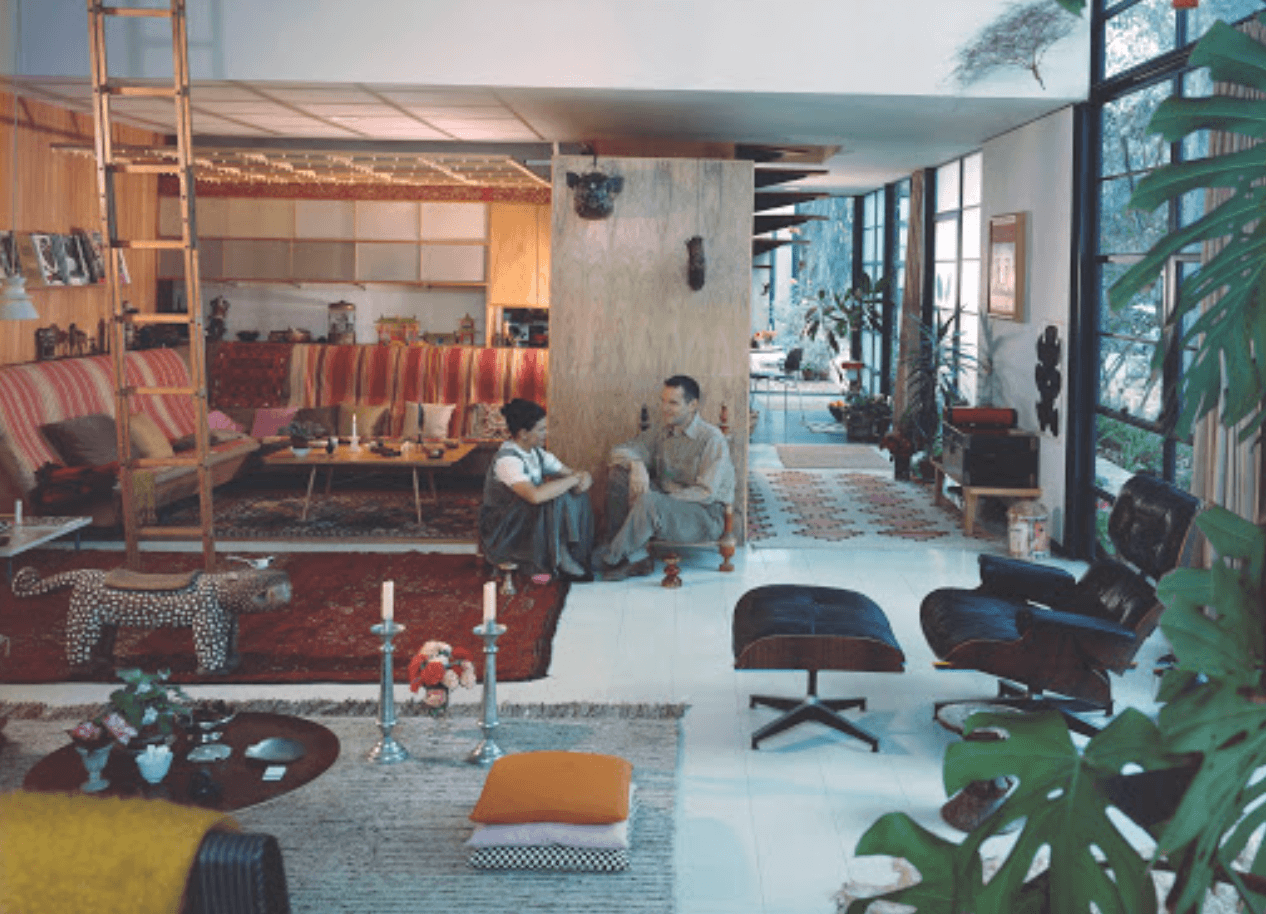
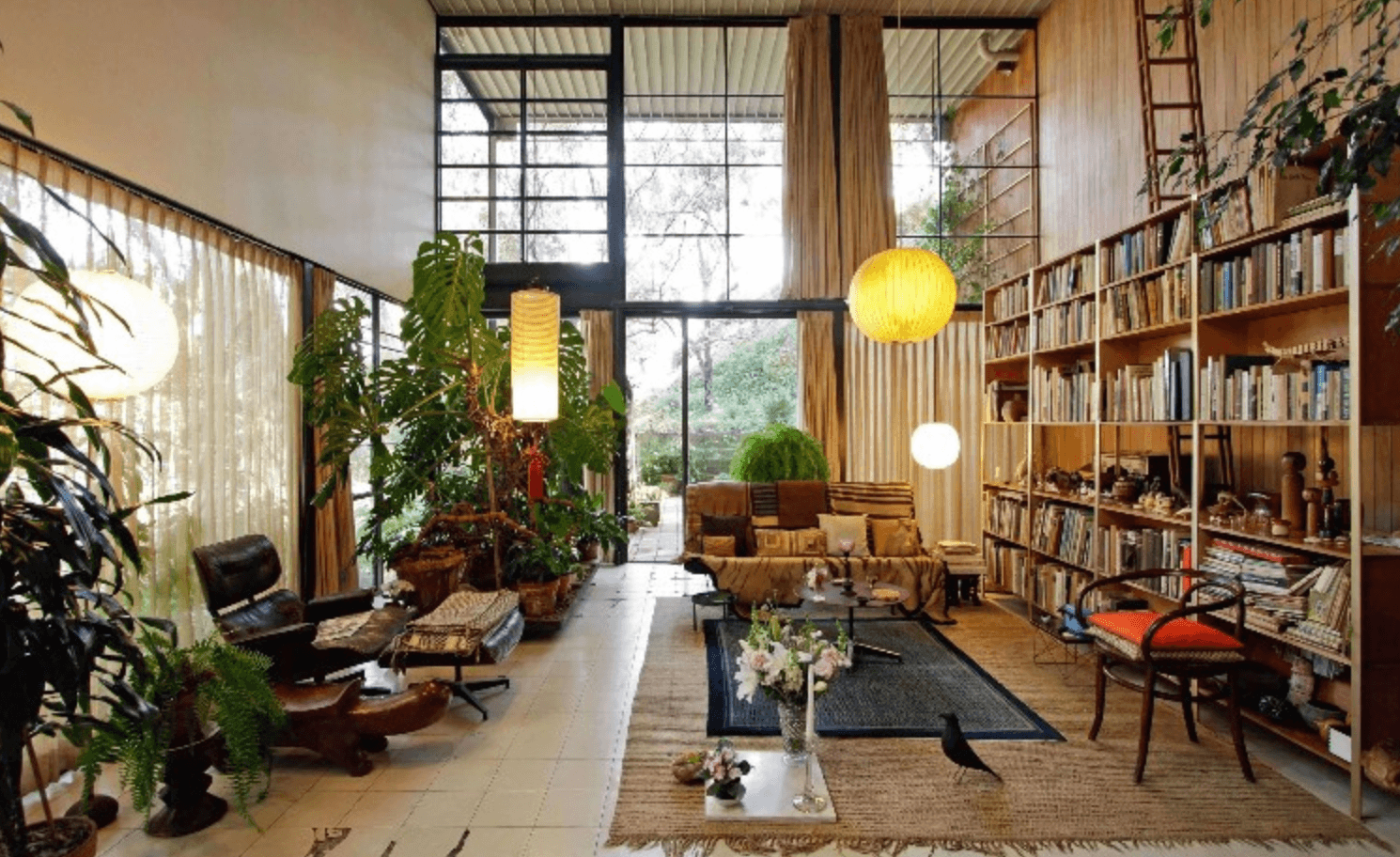
The living area of the Eames House, Pacific Palisades. Charles and Ray's own home demonstrates the principle perfectly: a few irreplaceable objects, chosen with absolute conviction, define the entire space.
Authentic Vintage vs. Reproduction: Why It Matters
The market for mid-century modern furniture is enormous — and for every authentic vintage piece, there are dozens of reproductions at various price points and quality levels. Understanding the difference matters practically, aesthetically, and financially.
Authentic vintage pieces carry provenance: potential a documented manufacture, your in essence closer to the designer. They were made from materials that are no longer available in the same quality — old-growth teak and rosewood that was cut and dried over decades before being worked, leather that has developed a patina impossible to replicate in new production. These materials age differently than their modern equivalents, becoming richer rather than worn.
Reproductions — including those manufactured under license by the original houses — are often excellent objects in their own right. But they are not investments in the same sense. A genuine 1960s Eames Lounge chair in original rosewood appreciates in value as collectors increasingly recognize the scarcity of early examples. A modern production Eames however well-made, does not carry that history and does not appreciate accordingly.
The practical test is simple: buy from a dealer who can speak to the provenance of a piece, who has done the restoration work transparently and to a high standard, and who stands behind what they sell. At Hobbs Modern, every piece in our collection is researched, authenticated, and restored — or left in original condition where appropriate — so that you know exactly what you are acquiring.
Final Thoughts: Building a Space That Lasts
Mid-century modern interior design endures because it was built on principles rather than trends. Its commitment to honest materials, purposeful form, and functional beauty was not a stylistic choice made for a particular decade — it was a conviction about how designed objects should relate to human life. That conviction doesn't age.
An interior built around authentic, well-restored vintage pieces is not simply a beautiful room — it is an investment in objects that will outlast the furniture imported from China in every big-box showroom. The teak credenza you acquire this year will be as beautiful in forty years as it is today. It will likely appreciate in value and it will carry, in its joinery and its grain and its proportions, the intelligence of a designer who believed that ordinary objects deserved to be extraordinary.
At Hobbs Modern, we specialize in curated, authenticated mid-century modern furniture — sourced, researched, and thoughtfully restored for collectors and homeowners who understand that distinction. Whether you are building your first MCM interior or deepening a collection you have been developing for years, we are here to help you find the pieces that will anchor your space for decades to come.
Browse our current collection at hobbsmodern.com — and when you're ready to talk about a specific piece or a room you're building, reach out. We love these conversations.