Table of Contents
- What Does Provenance Mean? A Clear Definition
- Provenance in Art History: Where the Concept Comes From
- Why Provenance Is the Most Important Factor in Vintage Furniture
- Real-World Provenance Examples in Mid-Century Modern Furniture
- What to look for in provenance
- Real World Provenance
- How Hobbs Modern Authenticates and Documents Provenance
- FAQs
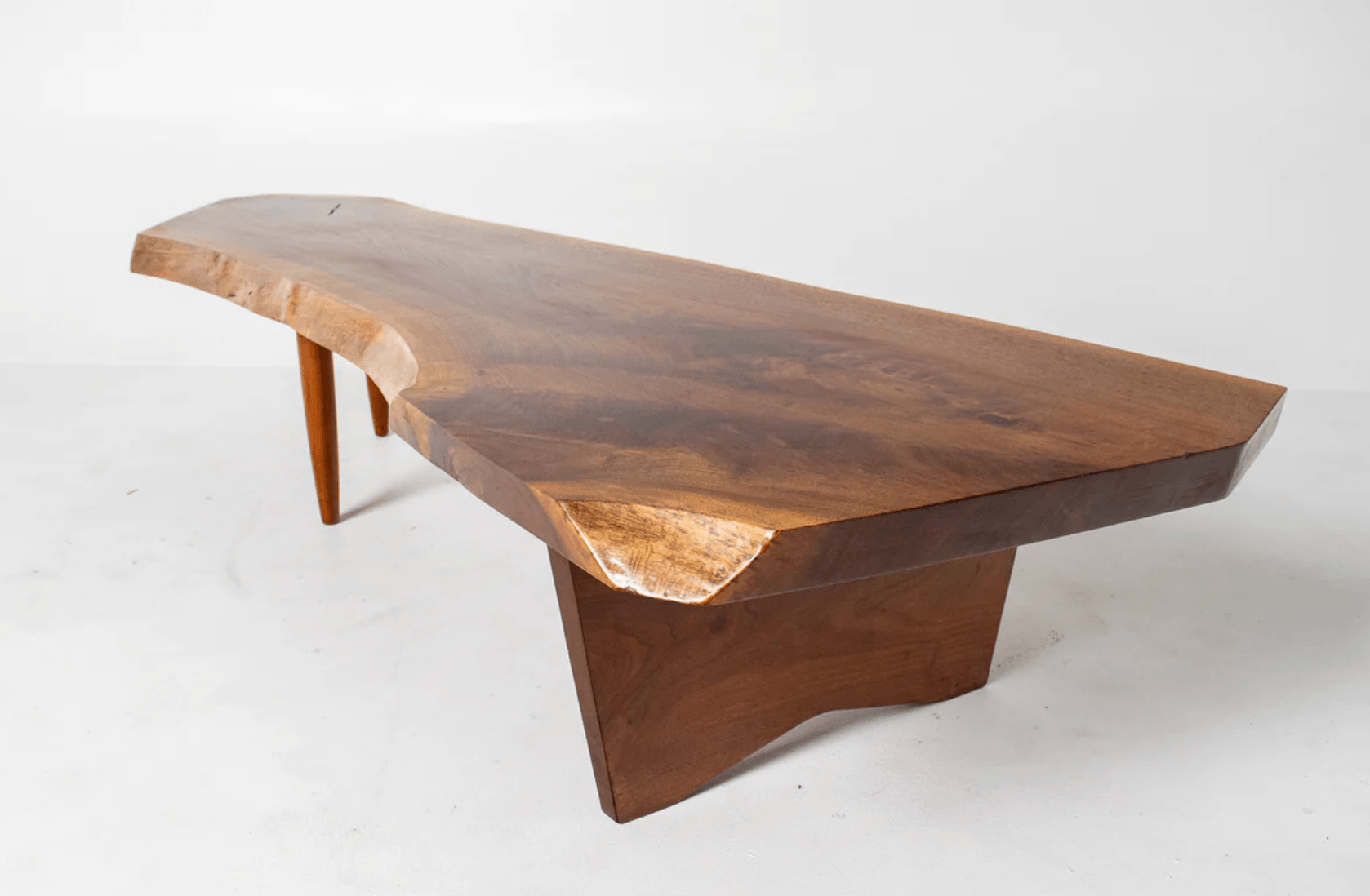
In the world of authenticated mid-century modern furniture, one word separates a confident purchase from a costly mistake. That word is provenance — and understanding it may be the most valuable thing you do before you buy.
What Does Provenance Mean? A Clear Definition
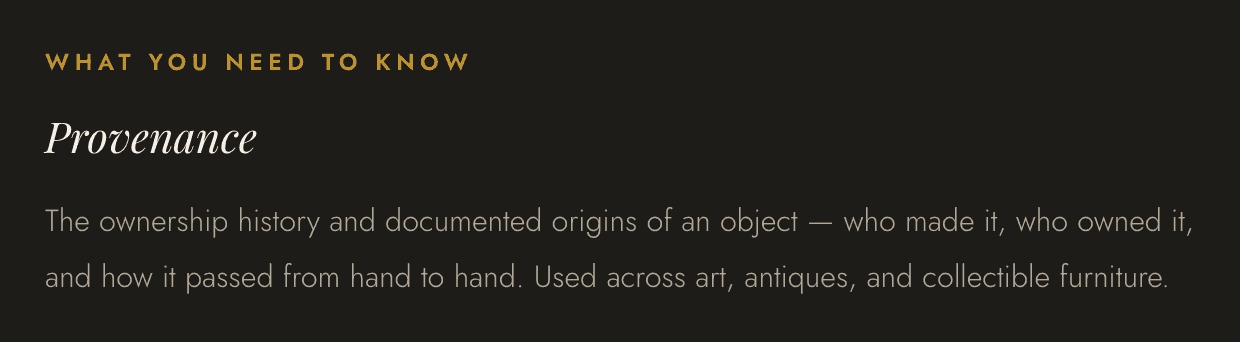
In plain terms, provenance answers three questions about any piece of furniture: Where was it made? By whom? And where has it been ever since?
For a mid-century modern buyer, provenance is the paper trail — and sometimes the physical evidence — that tells you an IB Koford Larsen Elizabeth Chair is genuinely what it's claimed to be, produced when it was claimed to have been produced, and owned by the people the seller says owned it. Without provenance, you're trusting words alone. With it, you're trusting evidence.
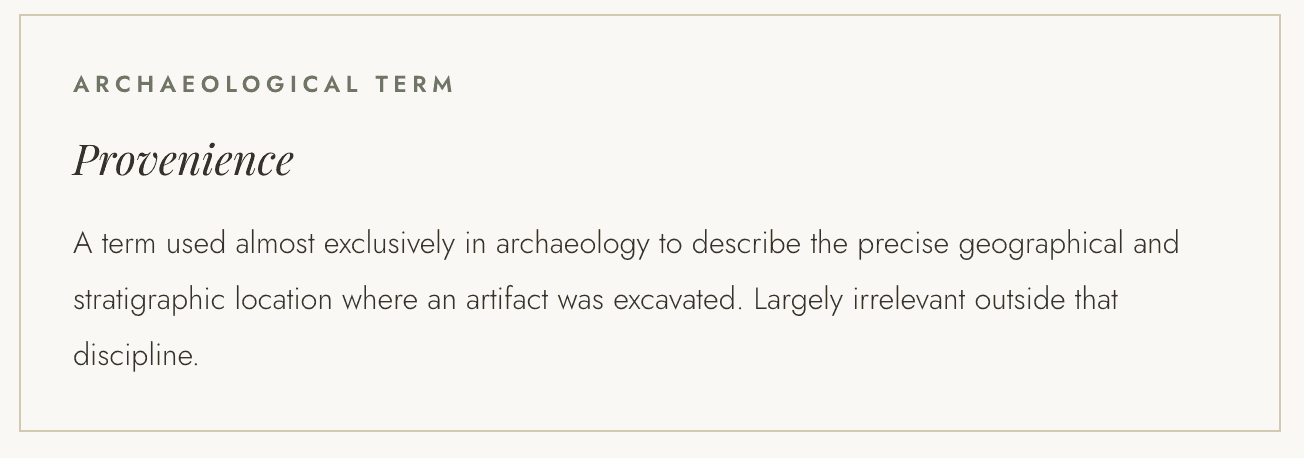
Provenance vs. Provenience: Understanding the Difference
These two terms sound nearly identical — and they're frequently confused. For vintage furniture buyers, only one of them matters.
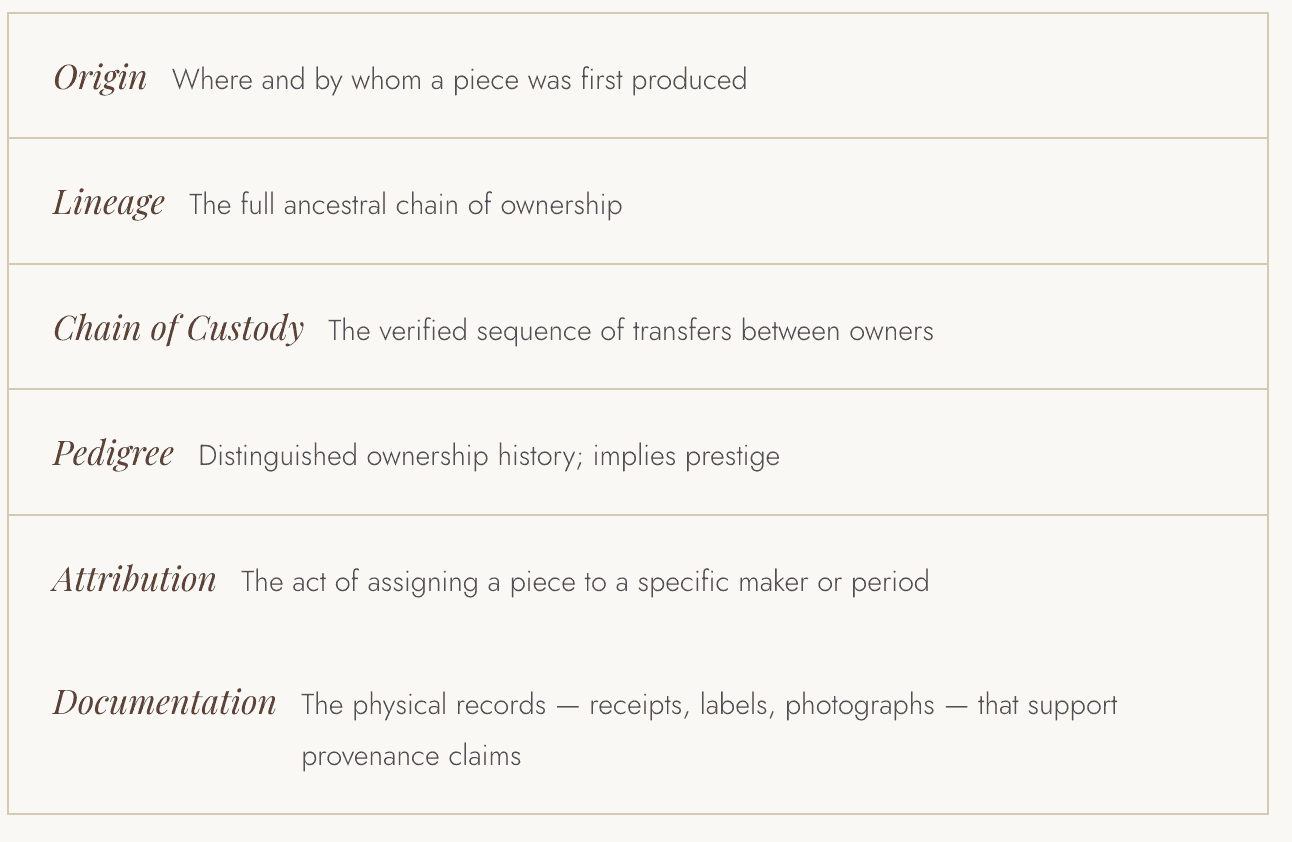
Provenance Synonyms and Related Terms You Should Know
Provenance in Art History: Where the Concept Comes From
Provenance didn't begin with furniture. The concept was born in the fine art world, where the stakes of misattribution have always been extraordinary — both financially and culturally.
As early as the 17th century, European art dealers and collectors understood that knowing a painting's history made it more valuable and more trustworthy. By the 18th and 19th centuries, major auction houses like Christie's and Sotheby's had codified provenance documentation into standard practice. Every important work that came to market arrived with a ledger of prior owners, exhibition records, and scholarly citations.

The 20th century made provenance even more urgent. The looting of art during World War II created an enormous body of works with deliberately obscured ownership histories, and the art world responded by developing rigorous international standards for provenance research. Institutions like the Getty Provenance Index and national laws governing cultural property made clear: an object without verifiable history is an object under suspicion.
This culture of documented accountability — built over centuries in the fine art world — is precisely the standard that serious vintage furniture collectors have imported into their own market.
From Art Galleries to Vintage Furniture: How Provenance Translates
When a Nakashima Dresser comes to market with original purchase documentation from a 1962 commission, collectors take notice. That is the furniture equivalent of a museum-quality provenance — and it commands a museum-quality price.
The translation from art world to furniture world is nearly one-to-one. Both involve:
- Original manufacture documentation (studio records, manufacturer's labels, Signatures)
- First-owner purchase records (receipts, commission letters)
- Exhibition or publication history (design journals, museum catalogs)
- Estate records
- Physical evidence on the object itself (labels, marks, hardware)
The difference is scale. A Basquiat painting may change hands with a team of lawyers present. A Hans Wegner lounge chair may change hands through an estate sale with a single hand-written receipt. But the principle — trace the object from maker to present day — is identical.
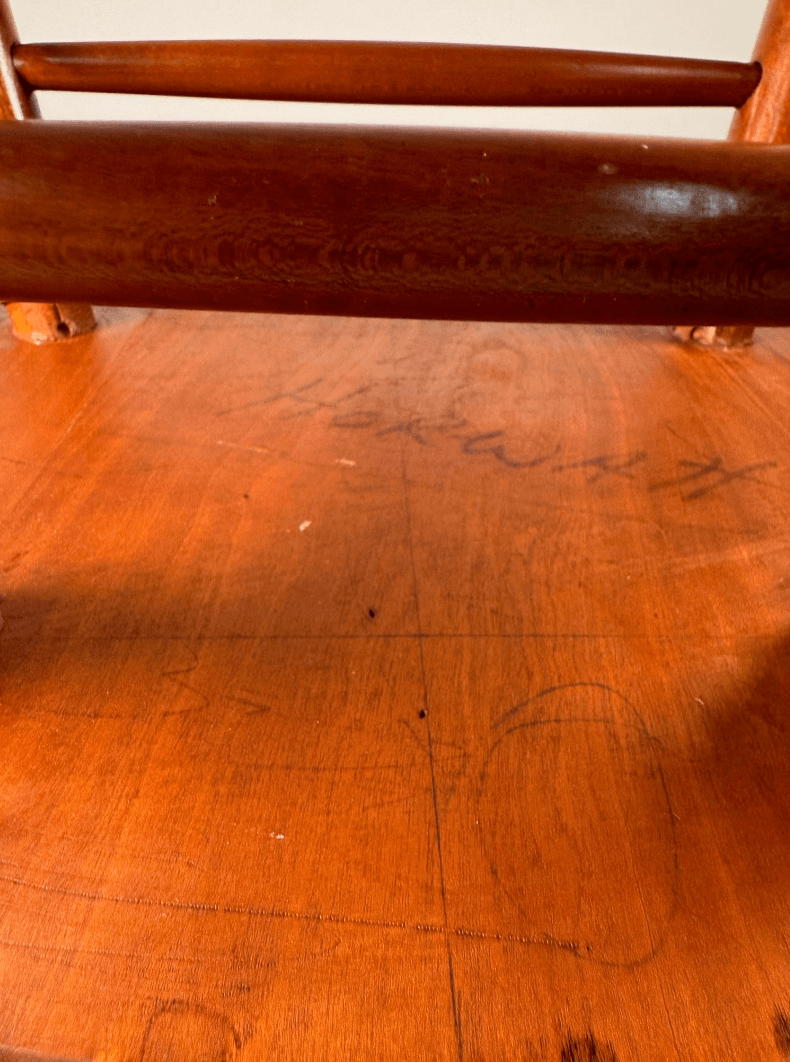 George Nakashima Captain Chair with orignal owners name. Nakashima was to humber to sign his own name so he always signed the clients last name. With original copies of receipts or original drawings names George Nakashima's work more valuable.
 Why Provenance Is the Most Important Factor in Vintage Furniture
From Art Galleries to Vintage Furniture: How Provenance Translates
When a George Nakashima piece comes to market with original commission documentation from 1962, collectors take notice. That kind of evidence is powerful, and when it exists, we use it. But the most important evidence in the MCM market is the object's own testimony: the construction techniques, the joinery, the materials, the hardware profiles, the patina. These things cannot be faked at the level a skilled restorer works.
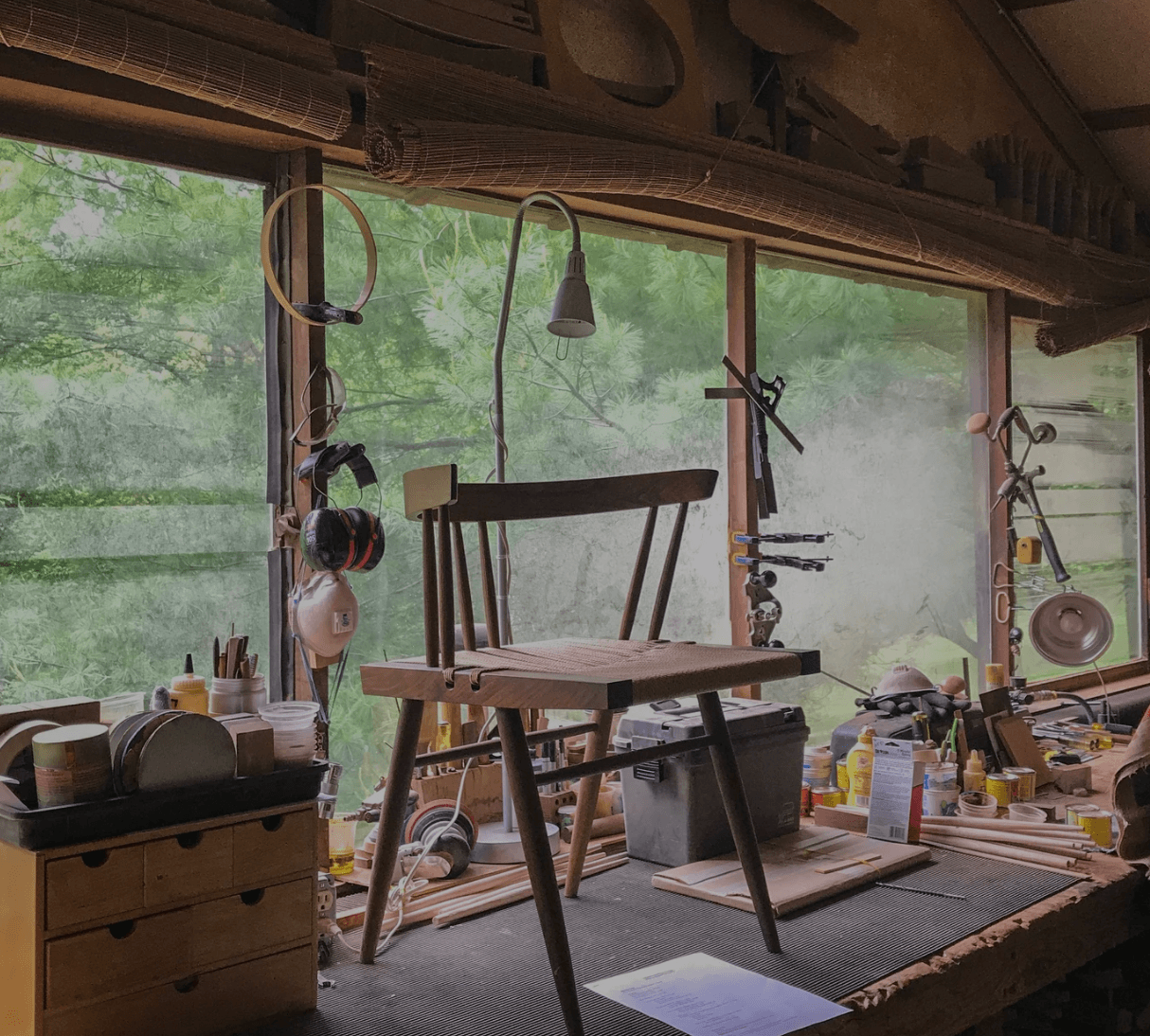
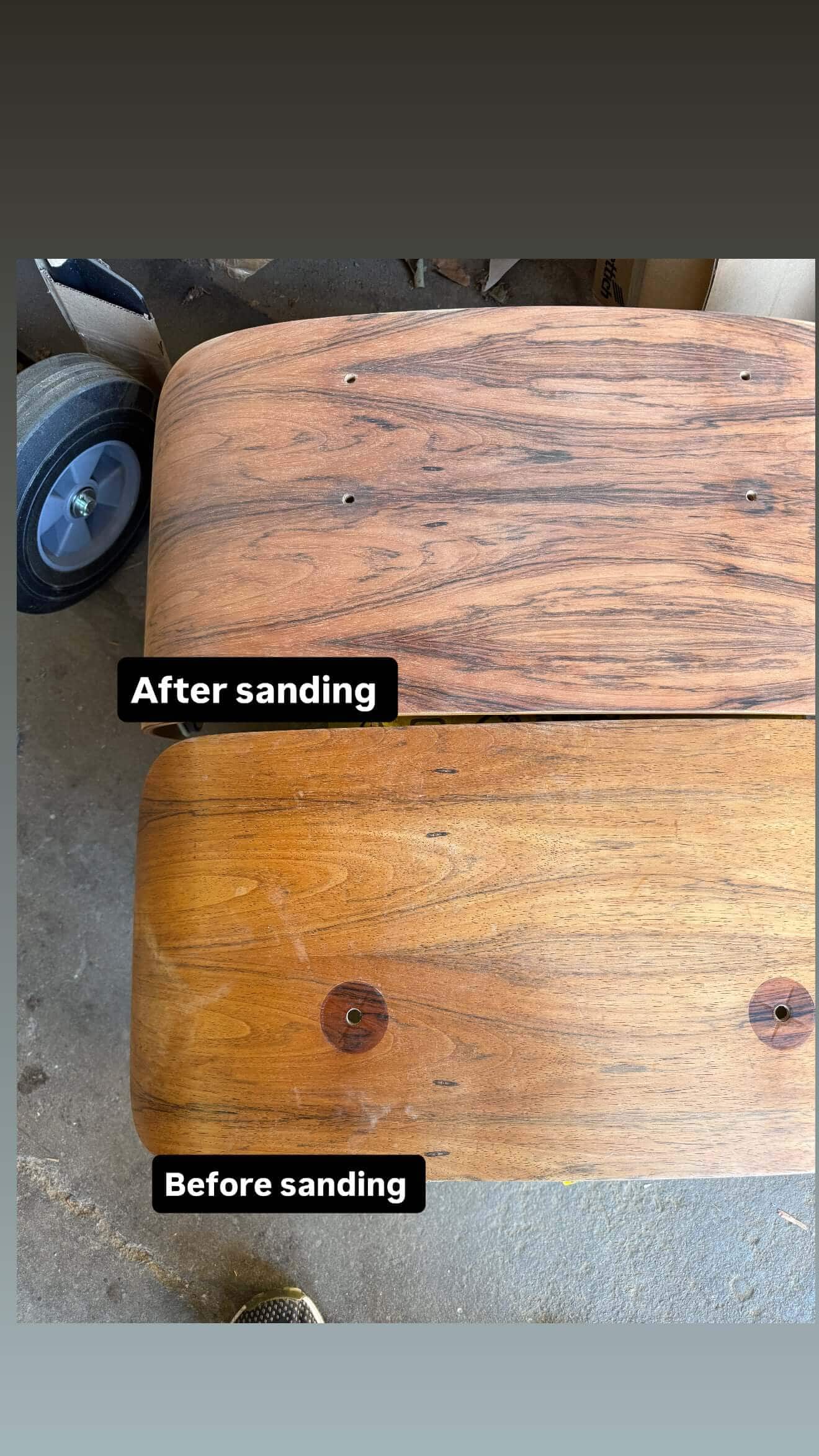
Because we restore and refinish pieces in our own workshop, we have insight that most dealers don't. We see the underside of every piece, the interior of every joint, the original upholstery beneath the layers. The categories of evidence we work with:
- Physical evidence on the object itself: construction methods, joinery, materials, hardware, patina
- Labels, stamps, and maker's marks when present — understood as helpful, not required
- Design literature and manufacturer archives for attribution of complex pieces
- Paper documentation (receipts, estate records, auction history) where it exists and is verifiable
We see this play out with pieces like our first-generation Eames Lounge Chair and Ottoman. A label is a useful data point. But what actually tells you you're looking at a first-generation example is the old-growth rosewood grain, the specific historically correct hardware, heavy metal bases with bootglides on the ottoman, the narrow then typical wing, the round clips, full feather leather cusihions, and three screws under the arms.
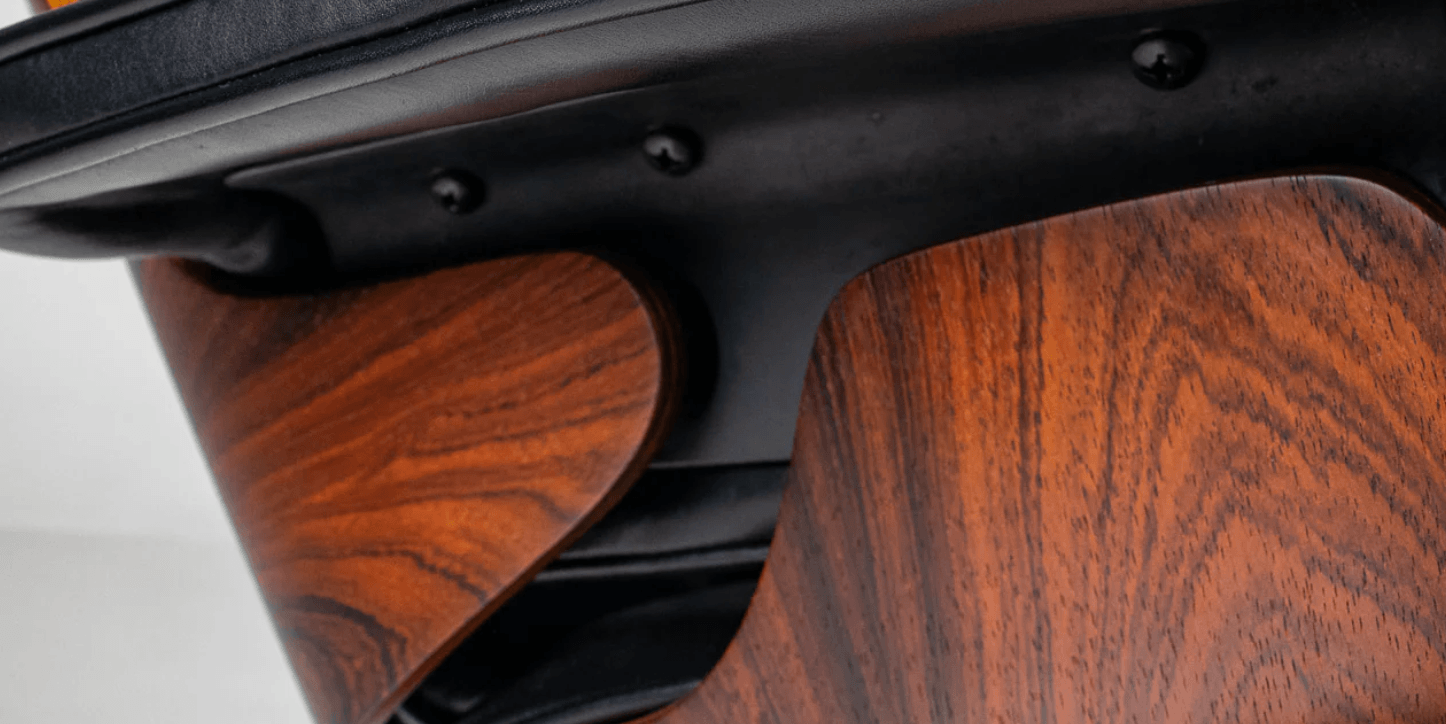 First Generation Eames Lounge Chair with Three Screws under the arm rests.
 Provenance Confirms Authenticity and Protects Against Fakes
The mid-century modern market has a counterfeiting problem that buyers consistently underestimate. Iconic designs — Eames chairs, Vladimir Kagans' sofas — are among the most reproduced objects in furniture history. Some reproductions are licensed and clearly labeled. Many are not.
The challenge is that high-quality reproductions can be difficult to distinguish from originals through visual inspection alone, particularly when they've been aged or distressed to simulate wear. Hardware, foam density, joinery, veneer grain — these take expert eyes and hands to evaluate. Provenance is the layer of verification that physical inspection cannot provide.
What Provenance Tells You That Your Eyes Cannot
When a seller provides a Herman Miller label photograph, an original receipt dated 1968, and documentation showing the chair's path from original owner to the present, they are offering you something more reliable than aesthetic judgment: a verifiable chain of evidence. A reproduction cannot have genuine 1968 paperwork. A misattributed piece cannot have correct manufacturer documentation.
When a seller relies entirely on staged listing photographs and vague attribution language — 'attributed to,' 'in the style of,' 'Danish, circa 1960s' — they are telling you something important, even if it's not what they intend. The absence of specificity is itself a signal. Reputable dealers can tell you exactly what they're selling and exactly why they believe it. Experienced buyers treat unexplained uncertainty as a reason to either walk away or substantially reduce their offer.
Provenance Directly Impacts Market Value
The premium for documented provenance is not subtle. In major auction results, pieces with strong ownership histories consistently achieve higher prices than comparable pieces with unknown histories — and for pieces tied to notable prior owners or historically significant commissions, multiples well above that are not uncommon.
This isn't irrational sentiment. It reflects the market's rational assessment of risk. A piece with verified provenance carries a lower probability of being misrepresented. Lower risk commands higher prices. The logic is identical to insurance underwriting: what is known and verifiable is valued above what is speculated.
For collectors building long-term portfolios of MCM furniture, this has a compounding effect. Pieces acquired with strong documentation retain their premium at resale. Pieces acquired without documentation must compete on aesthetics alone - wh
Provenance Builds Buyer Confidence When Shopping Online
Buying authenticated vintage furniture online requires a degree of trust that was once reserved for in-person gallery relationships. When you cannot physically inspect a piece, hold it, examine its underside, or assess the patina of its hardware under natural light, documentation becomes your primary instrument of evaluation.
Reputable online dealers know this. Transparent provenance documentation — photographs of labels, scans of original receipts, detailed condition notes, and clear attribution statements — is not just a courtesy. It is the mechanism by which trust is transferred across a screen. A dealer who provides thorough documentation is communicating something important: they have nothing to hide, and they are confident in what they're selling.
Conversely, a listing that offers only aesthetically staged photographs and vague attribution language ("attributed to," "in the style of," "Danish, circa 1960s") is telling you something important too — just not what you want to hear.
Real-World Provenance Examples in Mid-Century Modern Furniture
What does strong provenance actually look like for specific pieces? Here are three archetypes that reflect how documentation substantiates value in the MCM market.
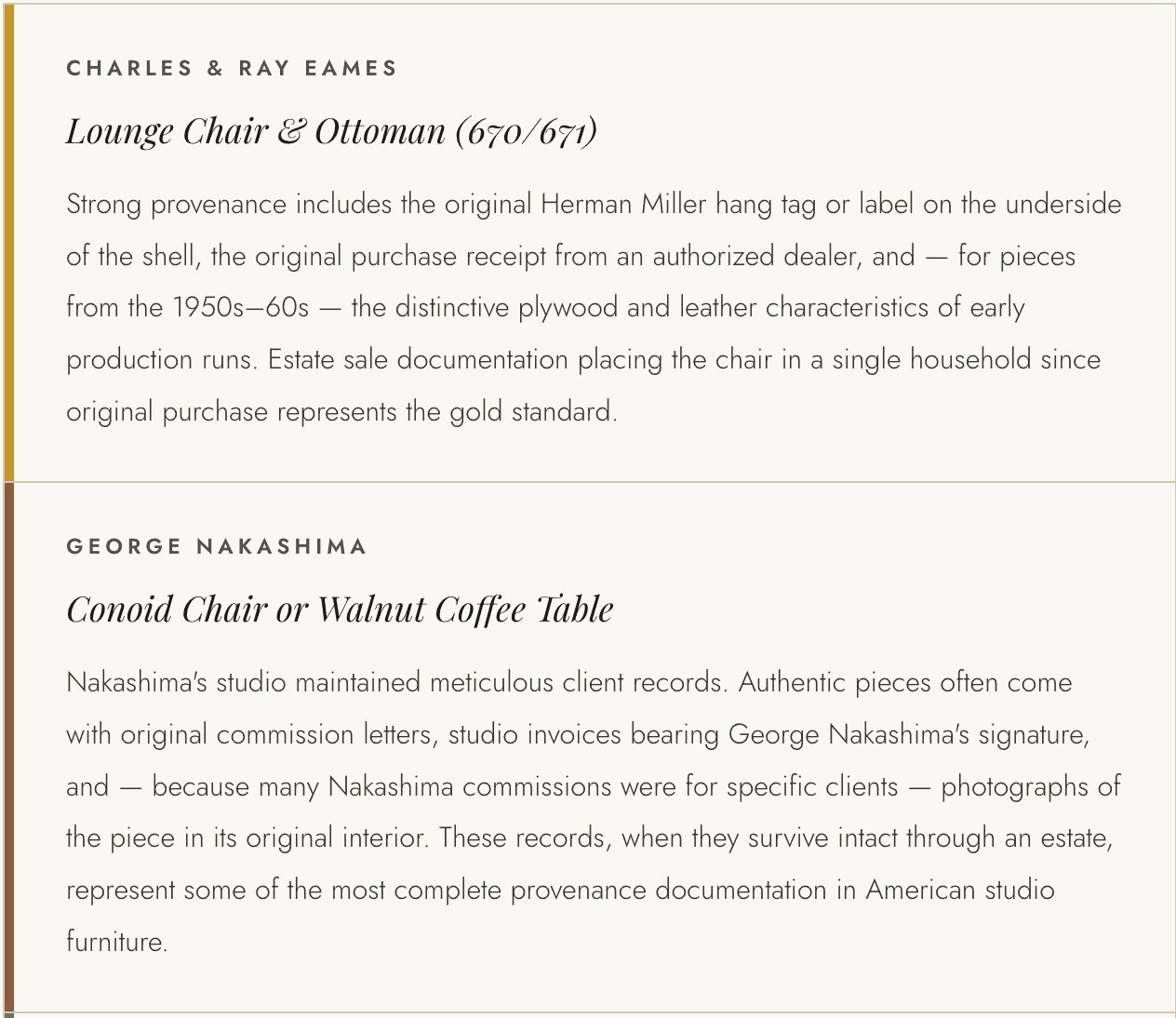
What to look for in provenance
Labels, Stamps, and Maker's Marks
Not all provenance documentation is equal. Understanding what constitutes strong versus weak documentation protects you from well-intentioned speculation dressed up as evidence.
Labels, Stamps, and Maker's Marks
Physical evidence on the piece itself is the first category of provenance — and in many cases the most reliable, because it cannot be retrospectively fabricated without altering the object. On authentic mid-century modern furniture, look for:
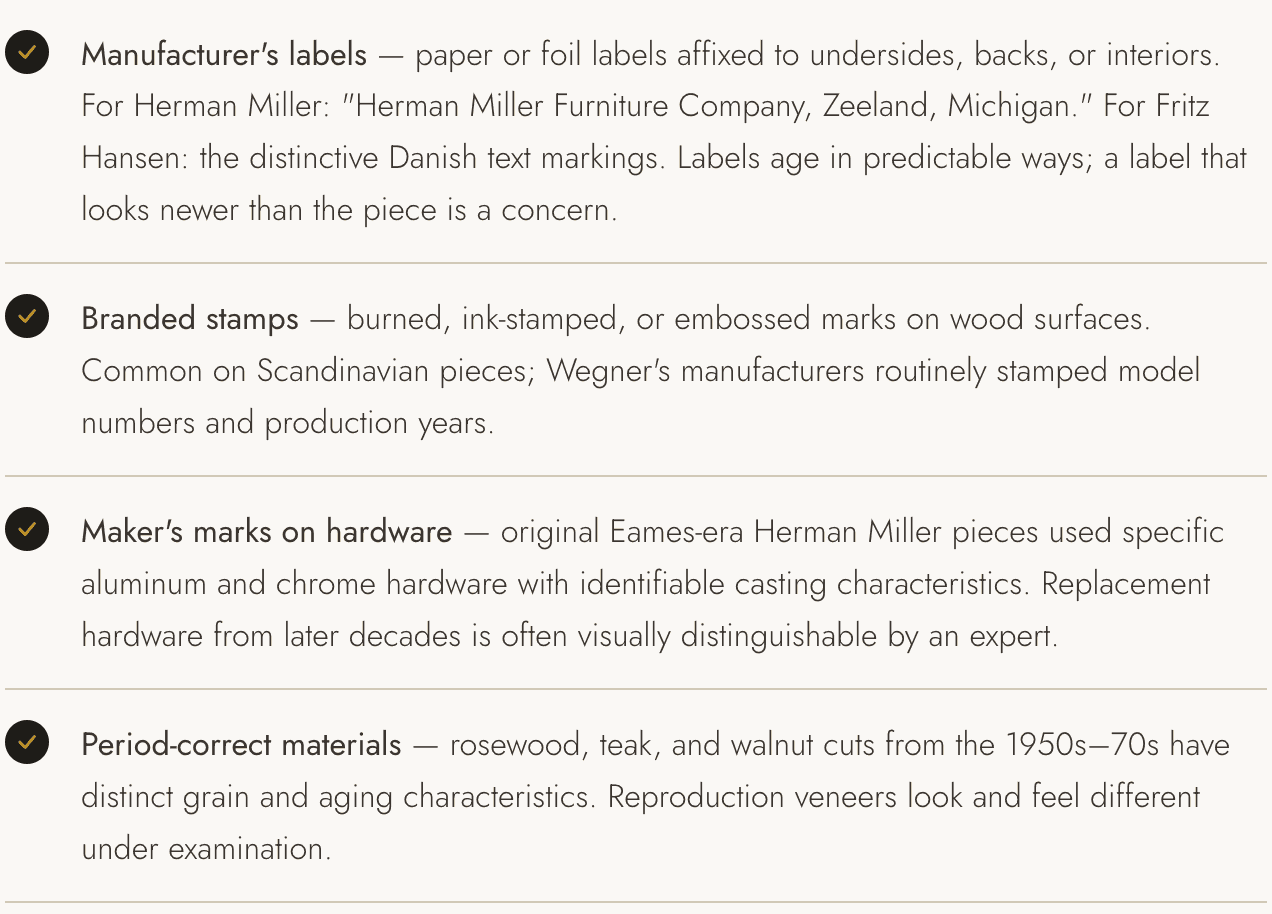
Purchase Receipts, Auction Records, and Ownership History
The paper trail is the second category — and for high-value pieces, often the most persuasive. Strong paper documentation includes:
Real World Provenance
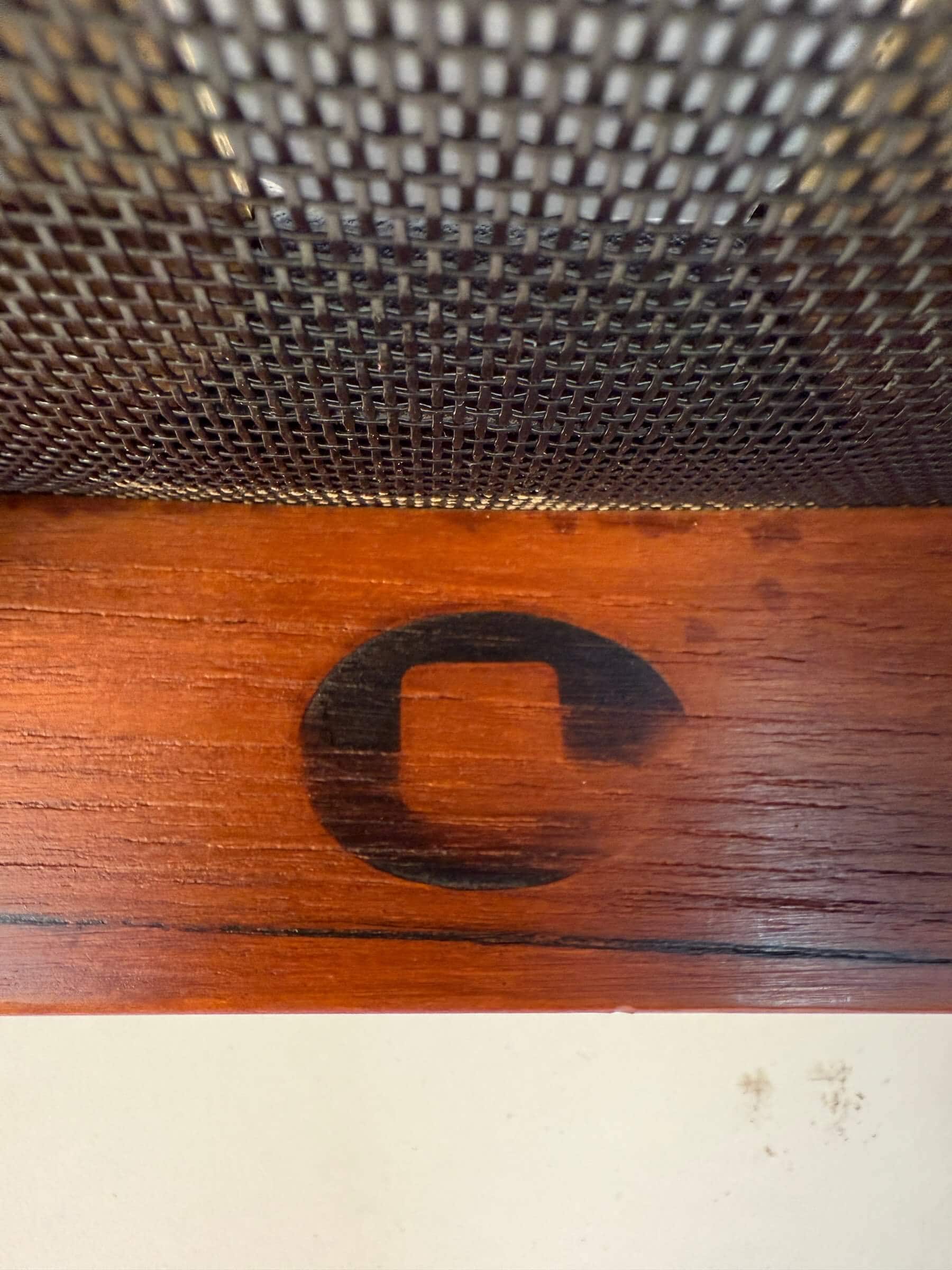
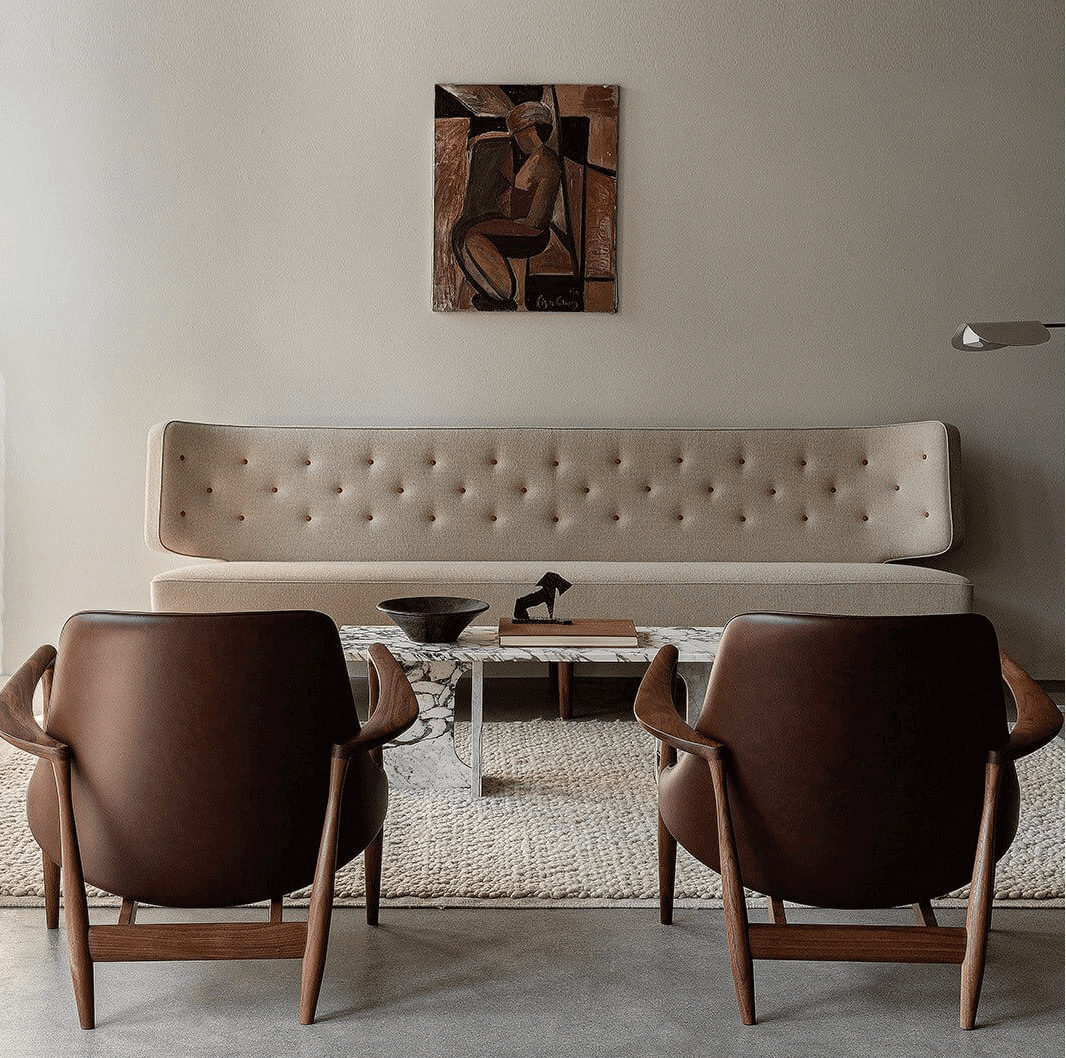
The IB Kofod-Larsen Elizabeth Chair. We currently have a pair in our inventory carrying both a Christian Larsens Møbelfabrik production stamp and an original George Jensen retail tag. Christian Larsens was the original Danish manufacturer; George Jensen was the premier Scandinavian design retailer who introduced Danish Modern to America. Having both is extraordinarily rare. Those two marks together tell a complete story, a perfect provenance— from the cabinetmaker's bench to the most significant retail channel through which American collectors first encountered this design movement. That documentation adds real, measurable value to an already exceptional pair.
How Hobbs Modern Authenticates and Documents Provenance
At Hobbs Modern, provenance is not an afterthought or a marketing claim. It is the foundation of every acquisition decision, every listing description, and every conversation we have with our clients . Our authentication process is built on the same standards used by the auction houses and museum collections — applied to each piece we bring into our San Diego showroom and online inventory.
Every piece undergoes hands-on inspection of labels, stamps, maker's marks, hardware, joinery, and materials. We examine undersides, backs, and interiors as carefully as front-facing surfaces. Period-correct aging, patina, and construction methods are evaluated against documented production standards for the designer and manufacturer in question.
We request and evaluate all available paper documentation — receipts, estate records, prior auction results, and photographs — before acquisition. Where documentation gaps exist, we note them transparently. We do not bridge gaps with speculation, and we price pieces accordingly based on the completeness of their record.
For pieces where attribution is complex — designs that were produced by multiple manufacturers across different decades, or pieces where the line between original and licensed reproduction requires careful navigation — we consult manufacturer archives, design literature, and specialist references to establish accurate attribution before listing.
Many Hobbs Modern listing includes an Authenticity statement: what is known, how it was verified, and what documentation will transfer to the buyer. We photograph labels, stamps, and any supporting paper documentation. What we know, you know — and it travels with the piece.
Our commitment is simple: when you buy from Hobbs Modern, you're not buying a story. You're buying a record.
FAQs
What exactly is provenance, and why does it matter for mid-century modern furniture?
It is the physical evidence — and when it exists, the paper trail — that confirms a piece is genuinely what it's claimed to be. Without it, you're trusting words alone. With it, you're trusting something verifiable.
How do I know if an Eames Lounge Chair is a genuine example?
How do I know if an Eames Lounge Chair is a genuine example?
Look at the physical details that cannot be copied: period-correct rosewood veneer, the historically correct hardware , the shock mounts giving the chair its iconic cantilevered shape. A Herman Miller label adds confidence when present. At Hobbs Modern, we assess all of these before listing any Eames Lounge Chair.
What's the difference between a licensed reproduction and a fake?
Licensed reproductions are produced with authorization from the designer's estate and are typically labeled as such. They are not fakes, but they are not originals, and they should never be sold as originals. Unlicensed copies — fakes — are a different matter entirely. Both can be difficult to distinguish from originals without expert physical assessment.
How does Hobbs Modern authenticate a piece of George Nakashima?
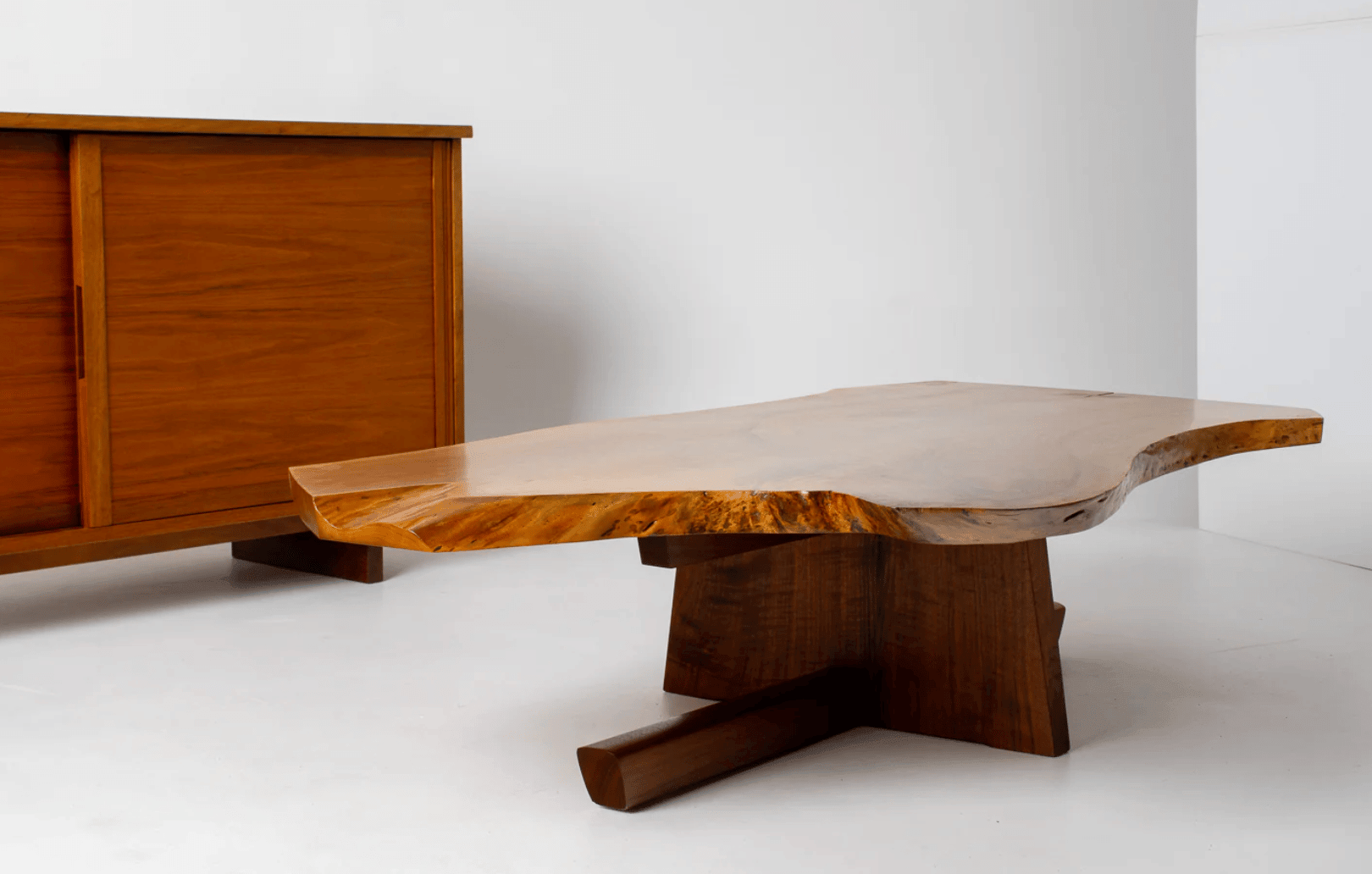
We have deep respect for what makes his work distinctive. Nakashima's furniture is inseparable from his philosophy: the deliberate grain orientation, the free-edge treatment, the butterfly joints, the hand-planed surfaces. In our workshop we examine the walnut figure, the mortise-and-tenon construction specific to the New Hope studio, and the tool marks consistent with hand work. We cross-reference against documented studio examples and published design literature. The piece itself carries the evidence.
Does authentication affect resale value?
Yes, authentication does significantly and consistently affect the price in the market place. Authenticated design achieves higher prices at auction than comparable pieces with unknown histories. A piece with clear authentication carries a lower probability of being misrepresented — and the market prices that accordingly. We've watched clients resell Hobbs Modern pieces years later at strong premiums precisely because our documentation of authenticity traveled with them
What does 'attributed to' or 'in the style of' mean — and should I be cautious?
'Attributed to' means a seller believes a piece is by a particular designer but cannot fully verify it. 'In the style of' means the piece resembles a designer's work without being their work at all. At Hobbs Modern, we don't use these phrases as shortcuts. If we can't verify attribution, we say so — and we price accordingly.
Why do some MCM pieces have no documentation at all — and is that a red flag?
For furniture sixty-odd years old, it's surprising when complete paperwork still exists. Many pieces entered the market through estate sales or informal transactions where no records were generated or retained. Absence of documentation doesn't mean a piece is inauthentic. It means physical evidence — construction methods, material consistency, hardware profiles, joinery technique — must do more of the authentication work. That's exactly the kind of work we're equipped to do.
How does Hobbs Modern decide which pieces to acquire?
Authenticity is our first filter. Before condition, aesthetics, or rarity, we ask: what do we actually know about this piece, and can we verify it? Because we restore and refinish in our own workshop, we have insight many dealers don't — into materiality, joinery, and the physical signatures of period production. That hands-on perspective is what drives every acquisition decision.