Table of Contents
- The Underrecognized Figures Who Helped Shape Mid-Century Modern Design
- Hugh Acton - The Cowboy Modernist
- Gilbert Rohde
- The Man Who Made Herman Miller Modern
- William Katavolos- The Designer Who Kept Going Beyond Furniture
- Ross Littell- The Graphic Mind Behind the T-Chair
- Douglas Kelley
- The Industrial Designer in the Trio
- The T-Chair: Three Designers, One Remarkable Object
- FAQs
The Underrecognized Figures Who Helped Shape Mid-Century Modern Design
Ask someone to name the great designers of the mid-century period and a familiar list usually emerges: Charles and Ray Eames, Hans Wegner, George Nelson, Florence Knoll, Eero Saarinen.
They deserve their reputations. But modern design wasn’t created by a handful of famous names.
Some extraordinarily influential designers remain comparatively unknown outside serious design circles. They experimented with materials before those materials became commonplace. They challenged how furniture was manufactured. They designed objects that museums would eventually consider landmarks. And, in some cases, they helped establish the ideas upon which much more famous designers subsequently built.
This series is about those people.
Not necessarily obscure designers—but designers you should know, and might not.
We begin with five Americans: Hugh Acton, Gilbert Rohde, William Katavolos, Ross Littell and Douglas Kelley.
Hugh Acton - The Cowboy Modernist
Hugh Acton’s story doesn’t begin in a design studio.
It begins on a farm and ranch in Nebraska.
Born September 17, 1925, Acton spent his childhood on his family’s property near Scottsbluff, Nebraska, tending cattle and crops. According to his obituary, he even kept a pet golden eagle. At fourteen, he designed and built a soapbox racer good enough to take him to the national championship in Akron, Ohio.
That combination of making things and physical experimentation seems to have followed him for the rest of his life.
Acton eventually attended Cranbrook Academy of Art in Bloomfield Hills, Michigan, graduating from its Design program in 1955.
To understand why that matters, you have to understand Cranbrook.
Cranbrook was less a conventional design school than a laboratory for American modernism. Eliel Saarinen conceived an environment where architecture, furniture, metalworking, textiles and art could overlap. Charles and Ray Eames, Florence Knoll, Eero Saarinen and Harry Bertoia were among the figures whose careers became intertwined with the school. Cranbrook describes Saarinen’s educational philosophy as encouraging students to understand everything from architecture to furniture and metalworking through experimentation.
Acton arrived in this environment during the postwar period.
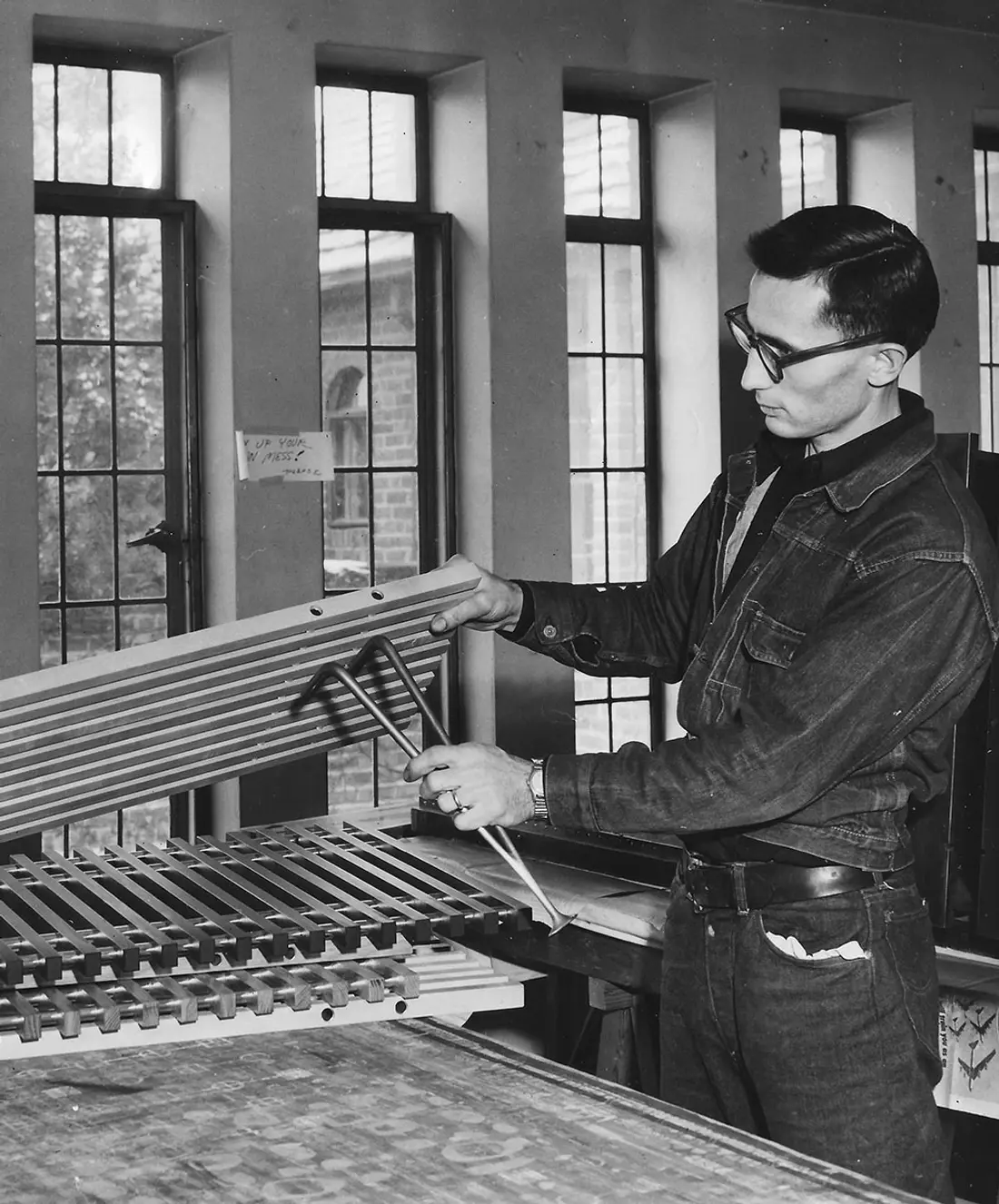
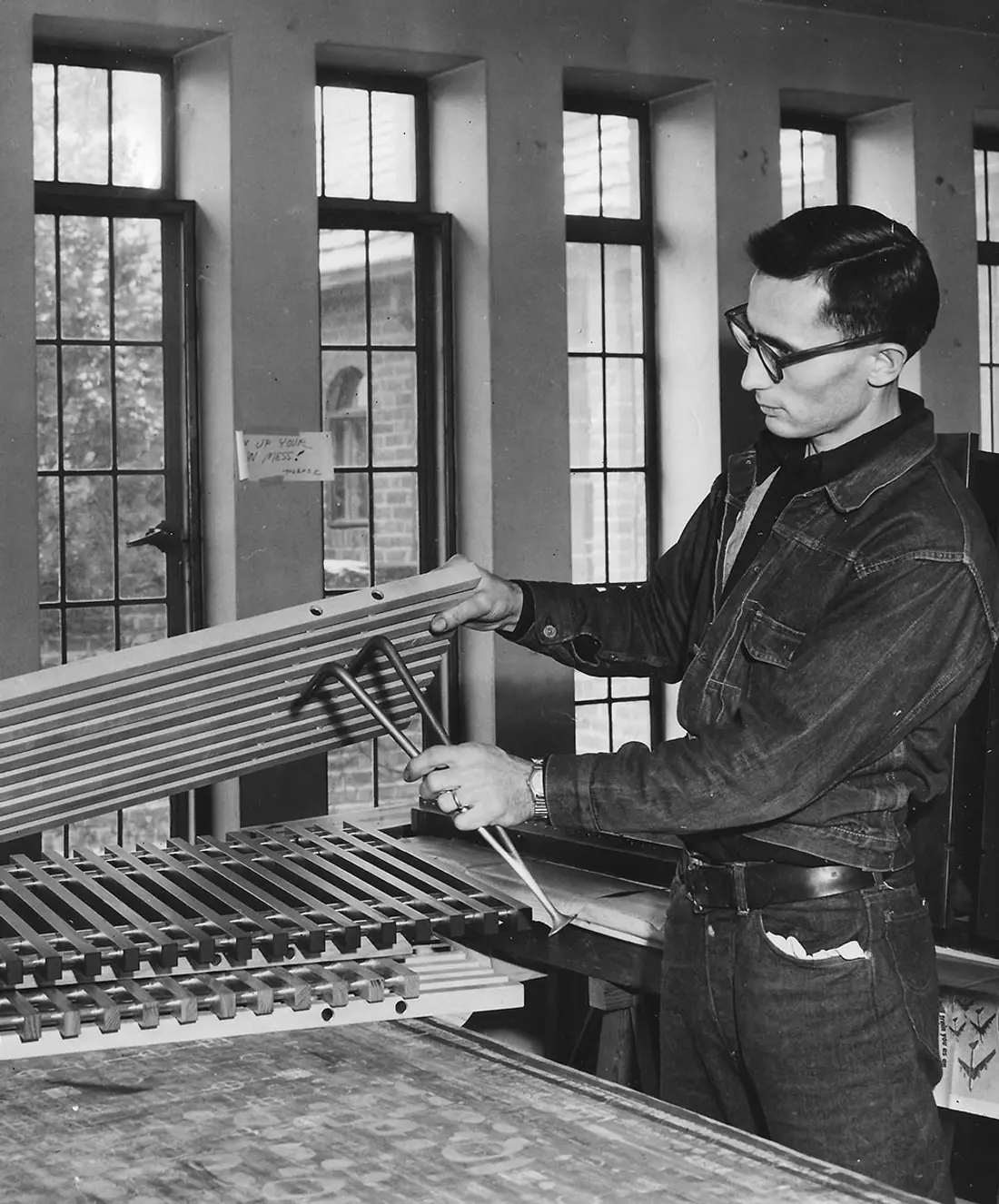
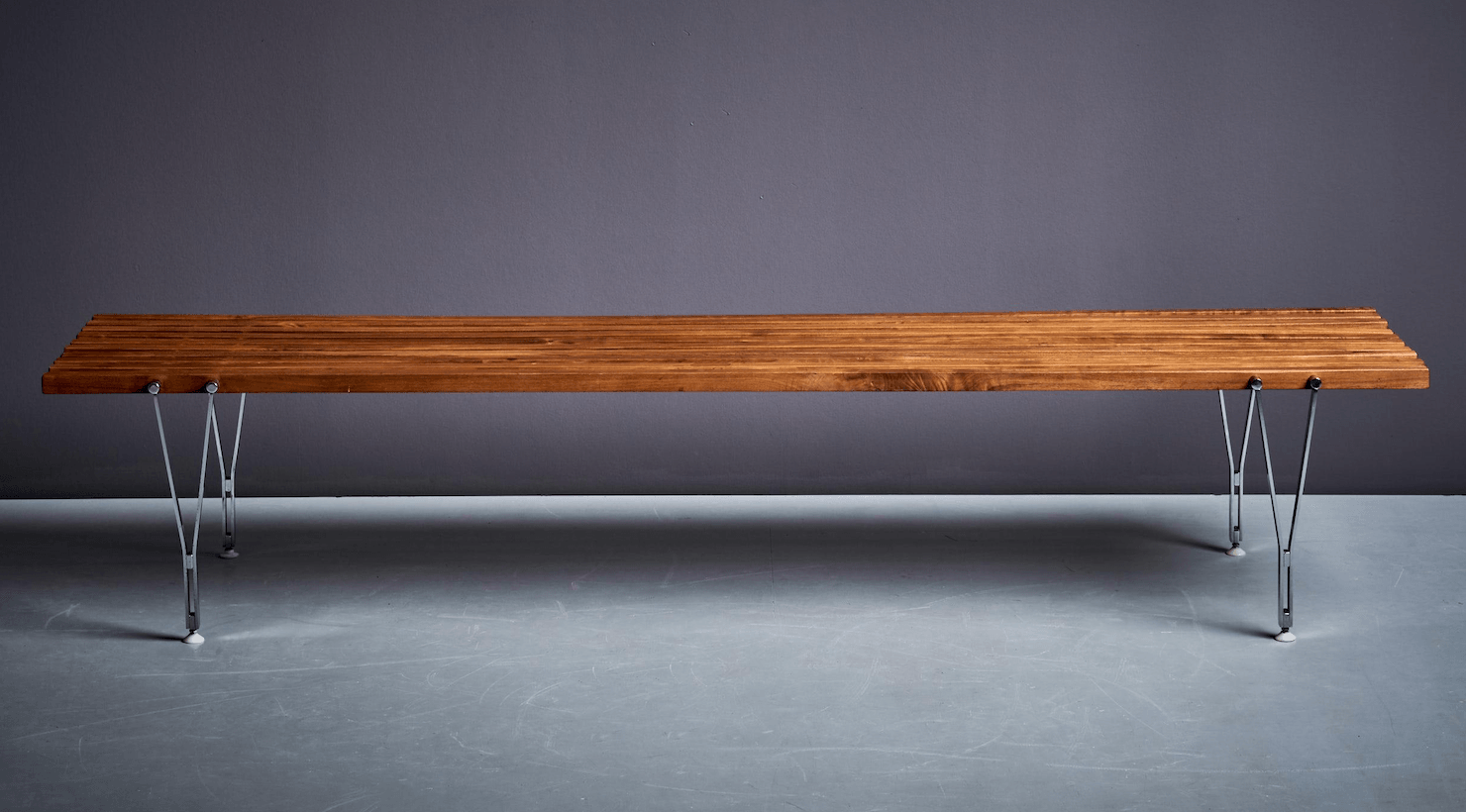
And in 1954, while still a student, he designed the object for which he is now best remembered: the Acton Slat Bench
The bench is almost radically simple: parallel wooden slats suspended over remarkably thin metal legs. Early examples were produced in walnut with brass; later versions incorporated chrome-plated metal.
Look at it next to George Nelson’s Platform Bench and the shared mid-century vocabulary is obvious. But Acton’s solution has a personality entirely its own. The delicate metal supports make the wooden surface appear almost weightless.
More importantly, Acton wasn’t necessarily thinking of furniture as a collection of isolated, precious objects.
He was interested in systems.
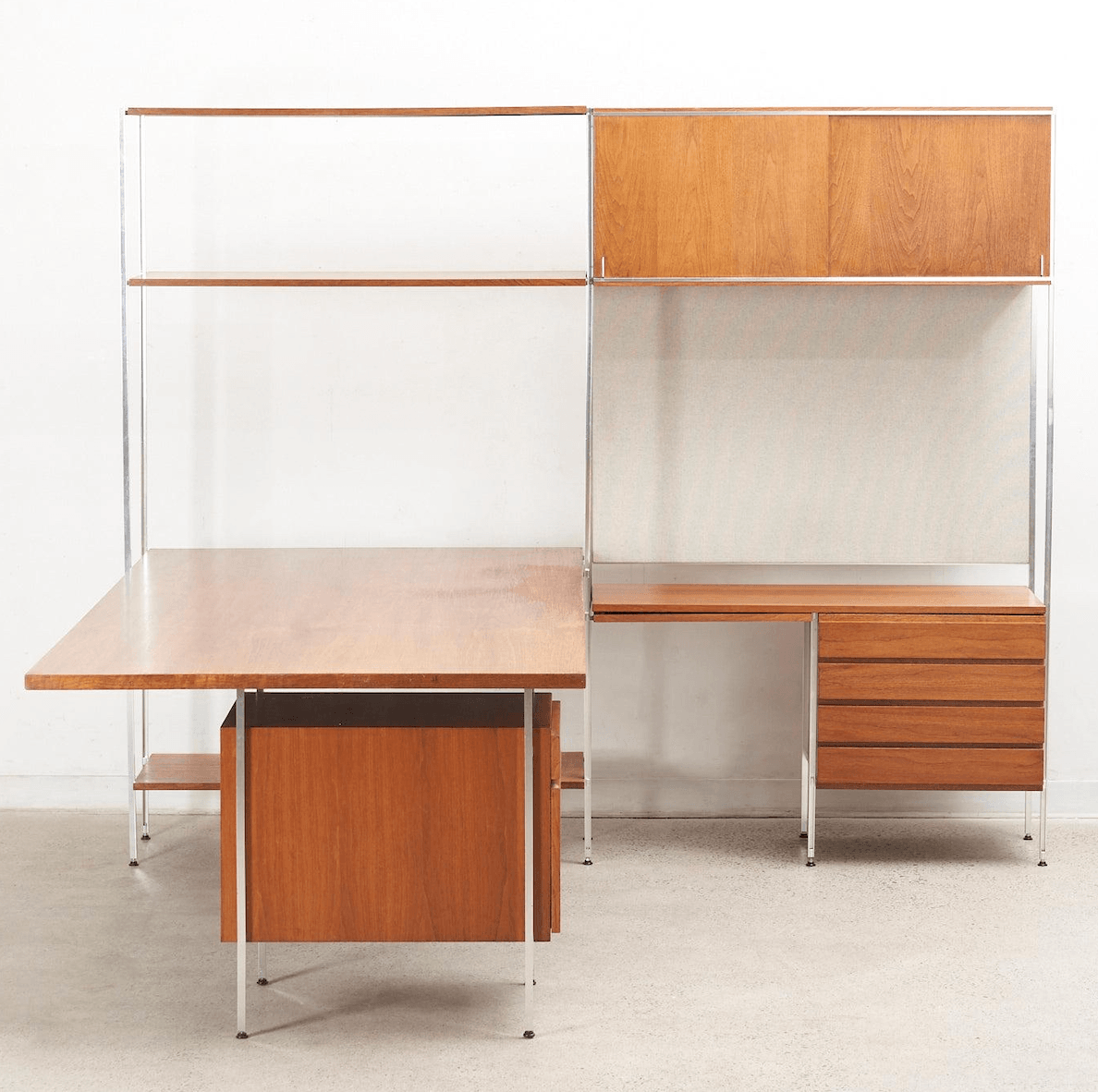
His furniture could expand, change configuration or perform different functions. Surviving modular wall and desk systems demonstrate that thinking particularly well. A desk, shelving, storage and architectural framework could become parts of a larger visual structure.
There is fascinating contemporary evidence for how he actually produced furniture. In a Smithsonian Archives of American Art oral history, designer Gerald Jerry recalled that Acton took advantage of the network of specialist manufacturing shops surrounding Detroit. Individual components could be fabricated by different shops and then brought together for assembly. Jerry remembered Acton operating a warehouse where the components were assembled into finished furniture, including pieces upholstered in Knoll fabrics.
Rare Hugh Acton Carrara Marble Coffee Table / Bench
$6,495.00
A rare and exceptionally elegant Hugh Acton coffee table or bench, featuring a substantial Carrara marble top supported by Acton’s unmistakable sculptural metal base. This unusual marble version elevates one of Acton’s most recognizable mid-century forms, combining the visual weight… read more

In other words, Acton wasn’t simply designing shapes. He was designing ways of making things.
His experimentation continued. He later designed the Acton Stacker for American Seating, a highly practical stacking chair. Cranbrook itself credits Acton with designing the first ergonomic stacking armchair.
Yet furniture was only one part of his life.
Acton was also a sculptor and jewelry designer. People who worked with him remembered his silver jewelry as particularly accomplished. And the athleticism of his youth never disappeared. In 1967, he won the Michigan Cyclo-Cross Championship—later joking that he won because his brakes failed. At 65, he became a national champion senior cross-country skier.
It’s difficult to separate those things from his furniture. Acton’s best work has an athlete’s economy to it: remove unnecessary weight, understand forces, use only what the structure requires.
He died in 2018 at 92.
For decades his 1954 bench remained something of an underground American design classic rather than a mass-produced icon.
That rediscovery feels appropriate.
Hugh Acton belongs in the story of American modernism not because he created hundreds of instantly recognizable objects, but because he embodied one of modernism’s central ideas:
Furniture wasn’t simply something to style. It was a problem to rethink.
Gilbert Rohde
The Man Who Made Herman Miller Modern
Gilbert Rohde occupies a peculiar place in American design history.
Almost everyone interested in mid-century furniture knows Herman Miller.
Far fewer know the man who transformed it into a modern furniture company.
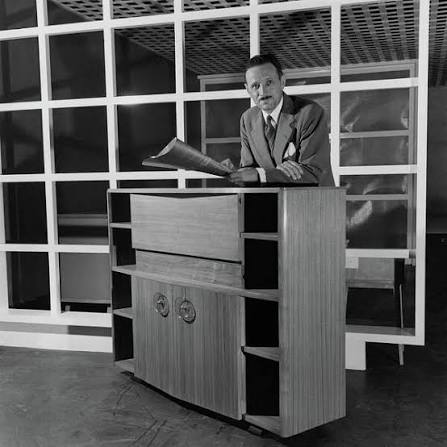
Rohde was born in New York in 1894 and attended Stuyvesant High School before studying art. Before becoming an industrial designer, he worked as an illustrator—including work for department stores such as Macy’s, Abraham & Straus and W. & J. Sloane—and opened his own design studio in New York in 1929.
A trip to Europe in 1927 exposed him to European modernism and the Bauhaus.
Then came 1930.
America was entering the Great Depression, and Herman Miller was in serious financial trouble. According to Herman Miller’s own history, the company was facing failure when Rohde walked into its Grand Rapids showroom looking for a manufacturer willing to produce his modern furniture.
What Herman Miller was producing at the time was largely traditional furniture based on historical styles.
Rohde told company president D.J. De Pree that this approach was fundamentally wrong for the way Americans were beginning to live.
Homes were changing. Cities were changing. Rooms were becoming smaller. Furniture needed to become lighter, more adaptable and more useful.
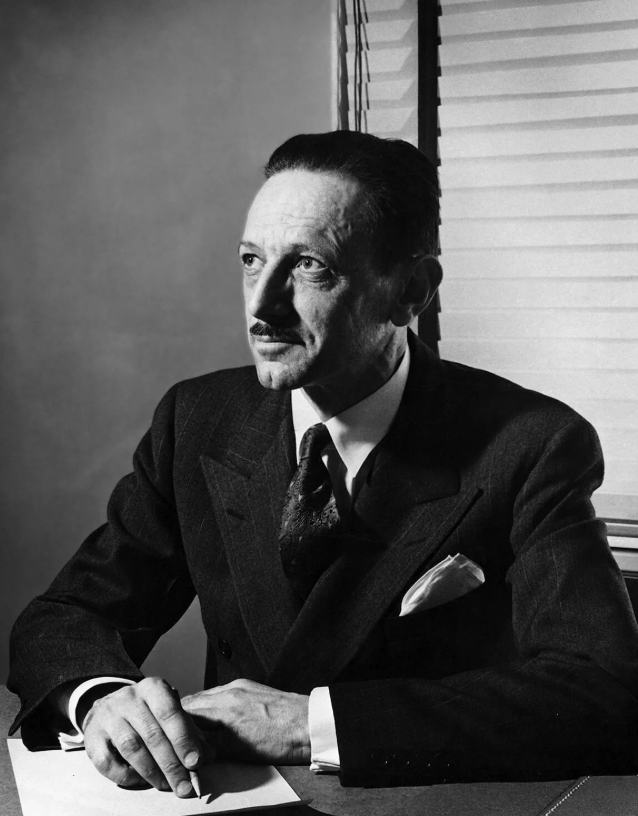
Rohde’s wonderfully simple philosophy was:
“The most interesting thing in the home is the people who live there.”
Herman Miller’s archive records that De Pree wasn’t initially convinced by the furniture—he thought Rohde’s designs looked plain. The struggling company also couldn’t afford to buy Rohde’s drawings outright. Instead, they arranged a $100 consulting fee and a three-percent royalty on sales, which Herman Miller describes as the industry’s first royalty contract.
The gamble changed the company.
Rohde pushed Herman Miller away from historical reproductions and toward modern furniture designed around contemporary life.
But here’s what makes Rohde particularly important: he didn’t just redesign the furniture. He helped redesign the business.
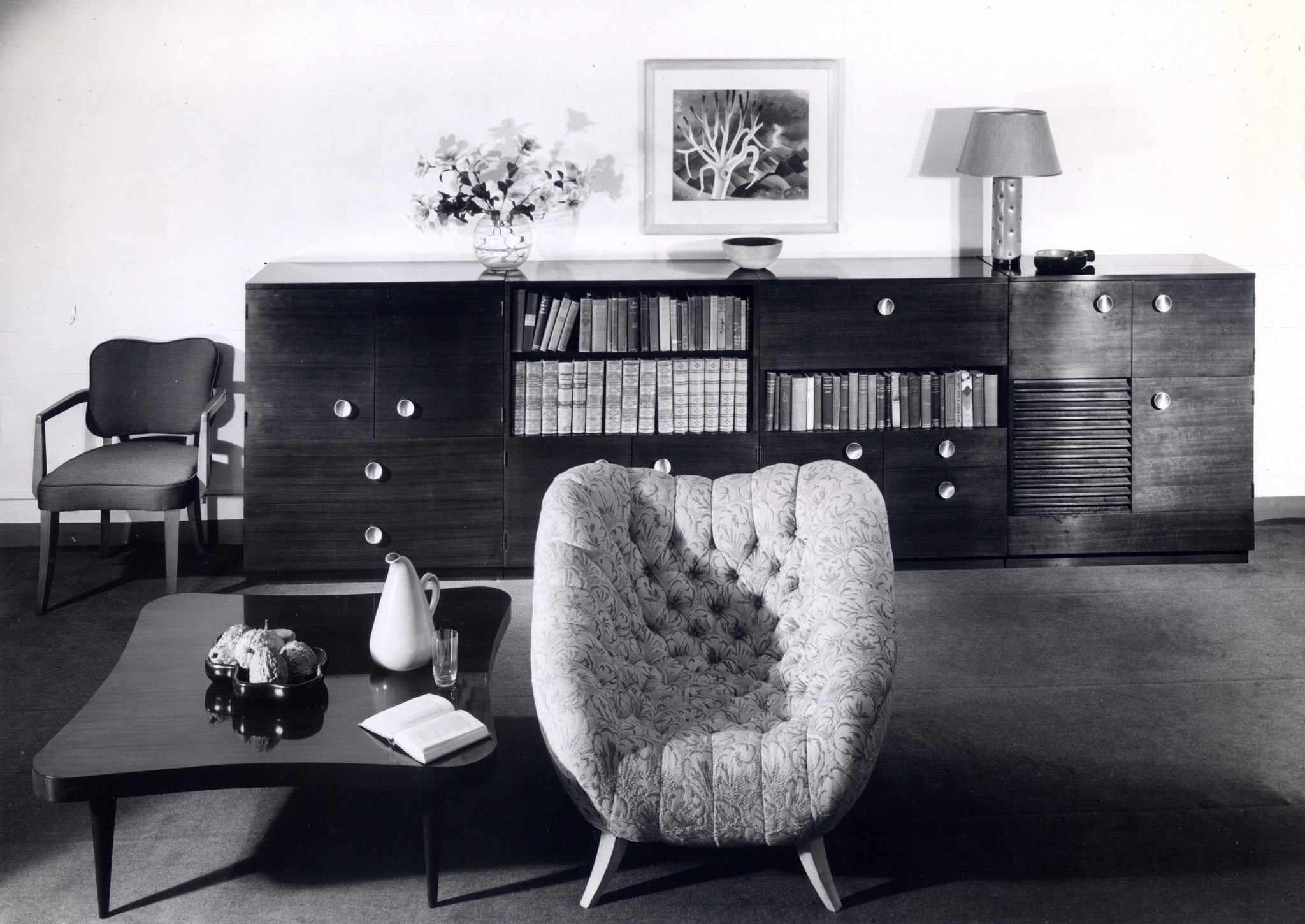
He advised manufacturing, developed catalogs and modern showrooms, and helped explain to customers why modern furniture made sense. In 1933, Herman Miller showed Rohde’s work at Chicago’s Century of Progress exposition, exposing millions of visitors to the company’s new direction.
Rohde was effectively building the language Herman Miller would later use to sell modernism.
His furniture also provides a fascinating bridge between Art Deco and what would become Mid-Century Modernism.
Gilbert Rohde for Herman Miller Bird’s-Eye Maple & Mahogany Dressers — Rare Matching Pair
$12,495.00
An exceptionally rare matching pair of Model 3626/3627 Dressers, designed by Gilbert Rohde for Herman Miller, beautifully illustrating the moment when American furniture transitioned from the streamlined glamour of Art Deco design into what would become Mid-Century Modernism. The striking… read more

His earlier work could incorporate exotic woods, polished metal, dramatic geometry and luxurious surfaces associated with Deco and Streamline Moderne. But ornament increasingly gave way to function, modularity and experimentation.
That transition makes his work especially interesting today.
A Rohde piece can sometimes look simultaneously 1935 and 1955.
He experimented aggressively with materials as well. MoMA owns his extraordinary circa-1938 chair constructed from stainless steel and Plexiglas. Only two prototypes are known. At a moment when structural plastics were still radically new, Rohde was already considering how transparent synthetic material could become furniture.
He worked with glass, chrome, Bakelite and other plastics and designed everything from furniture to clocks.
Perhaps even more consequential was his interest in modular furniture.
In 1942 Herman Miller introduced Rohde’s Executive Office Group, a modular and adaptable office-furniture system that foreshadowed the systems furniture for which Herman Miller would later become famous.
Rohde died suddenly of a heart attack in 1944, only 50 years old.
The following year, De Pree hired George Nelson.
Nelson would become enormously influential, bringing designers including Charles and Ray Eames, Alexander Girard and Isamu Noguchi into Herman Miller’s orbit.
But Nelson himself acknowledged the foundation already underneath him.
“We really stood on Rohde’s shoulders.”
That may be the simplest explanation of Gilbert Rohde’s importance.
Without Rohde, the Herman Miller we associate with American Mid-Century Modern design might never have existed.
William Katavolos- The Designer Who Kept Going Beyond Furniture
William Katavolos was born in New York in 1924 and graduated from Pratt Institute in industrial design in 1949.
At Pratt he met two other young designers: Ross Littell and Douglas Kelley.
The three formed a partnership.
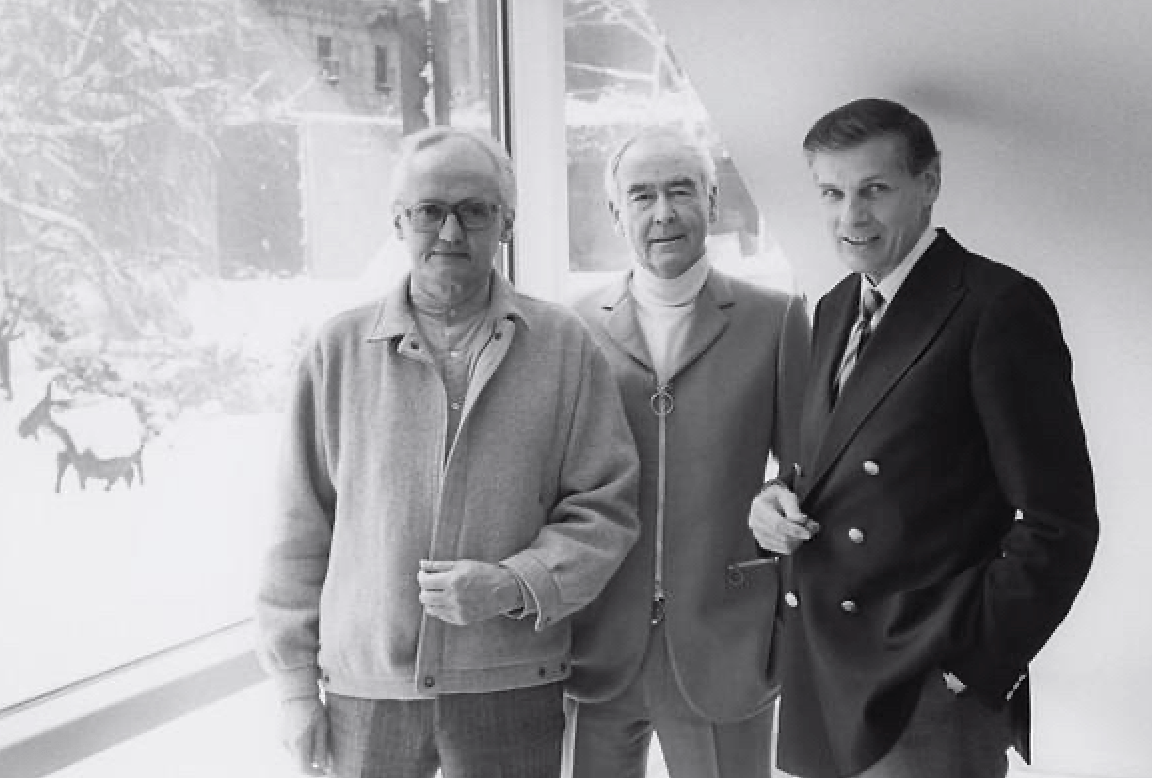
For approximately six years, they worked together across furniture, textiles and tableware, eventually creating a collection for Laverne International called simply “The New Furniture.”
The name sounds almost arrogant today.
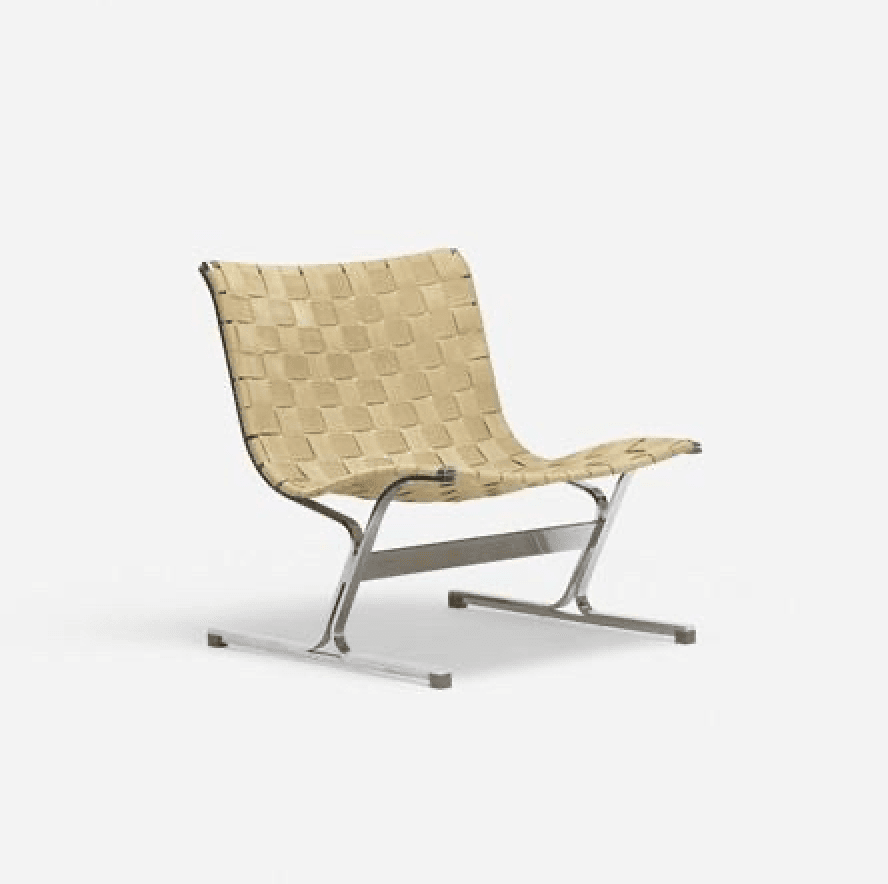
The designers argued that modern furniture shouldn’t merely sit inside modern architecture as decoration. It should behave almost like an extension of the architecture itself.
Their launch statement explained that they wanted furniture that would continue architecture’s lines and planes and operate as structural elements within the whole.
And no object expressed that philosophy better than their T-Chair.
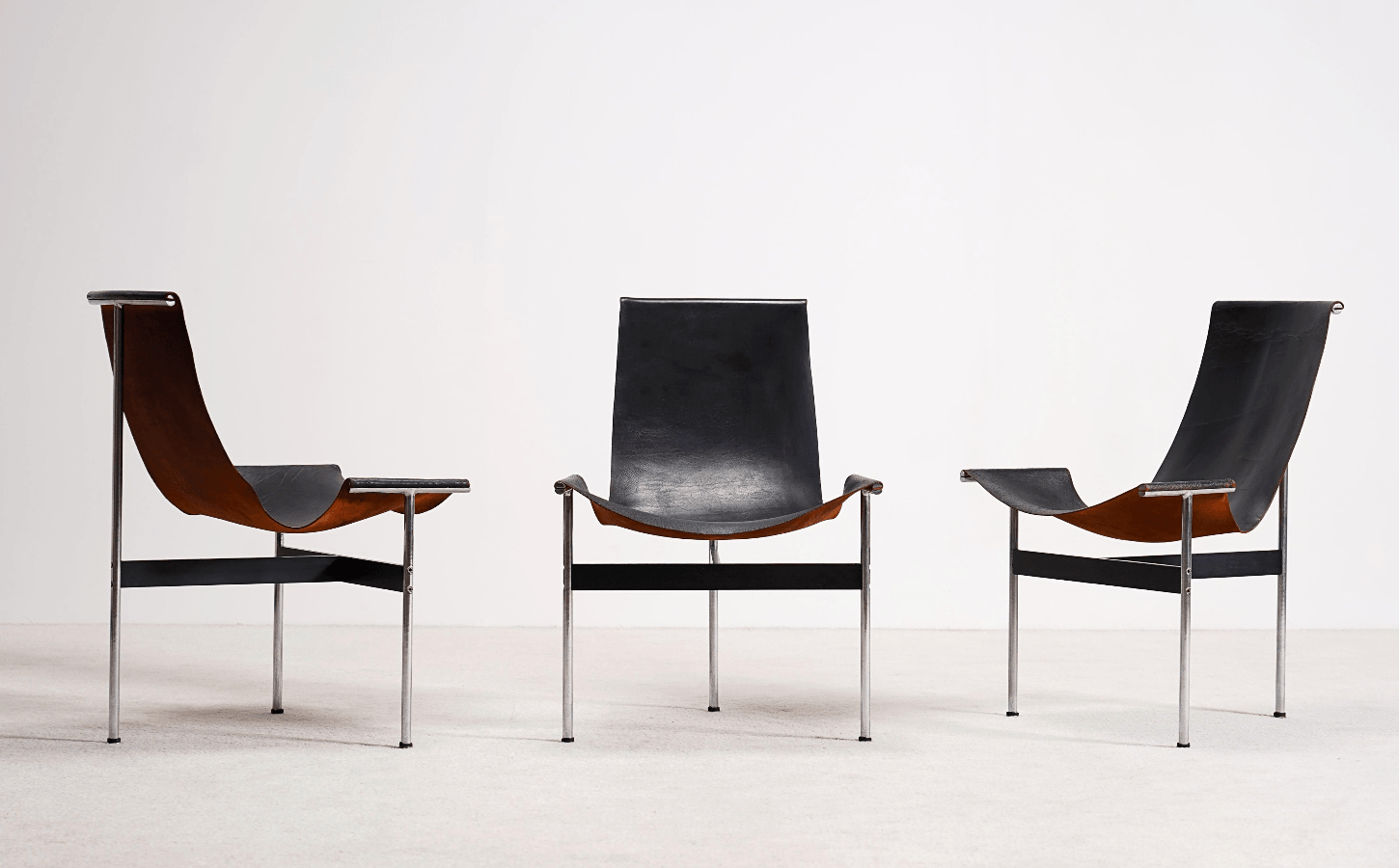
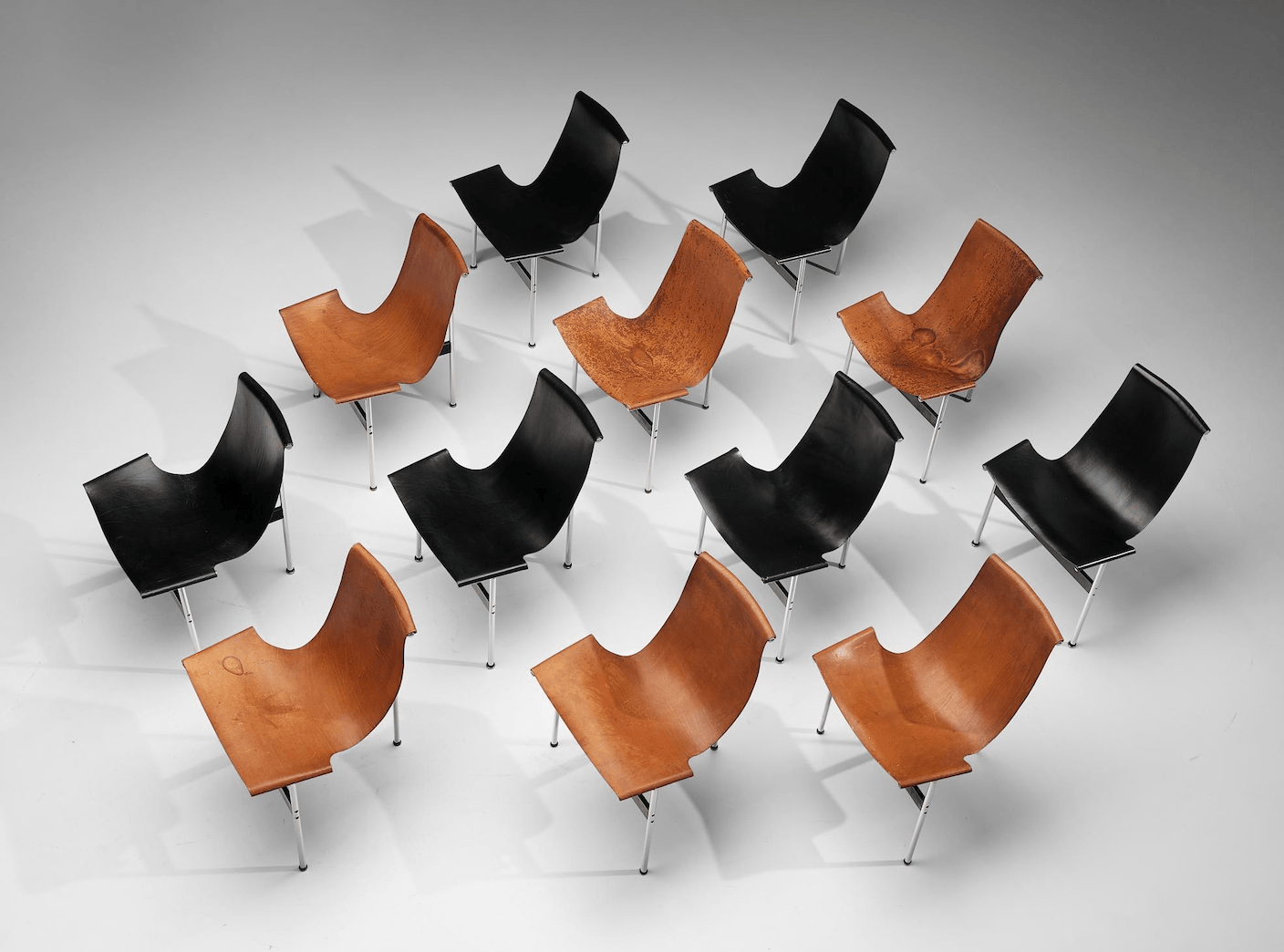
The chair was designed around 1952 from remarkably few elements: chromed steel tubing, black enameled steel and a thick leather sling. Three legs meet through a T-shaped structural arrangement.
There is almost nowhere for bad design to hide.
Remove the upholstery, padding, carved wood and decorative details of a conventional chair and what remains?
Structure.
Set of 6 Katavolos, Littell & Kelley for Laverne “T” Dining Chairs in Oxblood Leather
$16,795.00
A true icon of American modernist design, this exceptional set of six “T” Dining Chairs by William Katavolos, Ross Littell, and Douglas Kelley for Laverne International represents one of the most innovative seating designs of the mid-century era. Introduced in… read more

The Museum of Modern Art acquired an example, where it remains in the Architecture and Design collection. The Metropolitan Museum of Art also holds one.
But the T-Chair shouldn’t cause us to freeze Katavolos’s career in 1952.
Furniture was merely an early chapter.
Katavolos became increasingly interested in experimental architecture and structures. He eventually spent decades teaching at Pratt and became co-director of its Center for Experimental Structures. His thinking ranged from architecture and cities to biological structures and what he called organic design.
A 2006 interview in BOMB describes a career spanning six decades. Katavolos conceived partition systems, exhibition structures and pavilions and associated with a remarkable circle that included Frederick Kiesler, Eva Zeisel, Mark Rothko and Robert Motherwell.
His method remained unusually physical and visual.
Pratt recalled a 1994 description of visiting his studio: Katavolos seemingly couldn’t explain an important idea without immediately reaching for paper and drawing it.
That makes the T-Chair easier to understand.
It isn’t really an upholstered chair in the conventional sense.
It is almost a small piece of architecture.
A few structural members establish forces and geometry; leather stretches between them to accommodate the human body.
Katavolos died in 2020 at 96.
His career ultimately became much larger than furniture, but the T-Chair remains an extraordinarily concise demonstration of an idea that occupied him for decades:
Structure itself could generate form.
Ross Littell- The Graphic Mind Behind the T-Chair
Ross Littell’s path into design was different.
Born in Los Angeles in 1924, he grew up around making. His father worked in the Long Beach shipyards before operating a furniture showroom, while his mother created batiks that were used in Cecil B. DeMille films.
Littell won a four-year scholarship to the Art Center School in Los Angeles, but World War II interrupted his studies. He served in the Coast Guard and afterward enrolled at Pratt Institute in New York.
Set of Ten T Dining Chairs by Katavolos, Littell, & Kelley For Laverne International
$27,995.00
A true icon of American modernist design, this exceptional set of ten “T” Dining Chairs by William Katavolos, Ross Littell, and Douglas Kelley for Laverne International represents one of the most innovative seating designs of the mid-century era. Introduced in… read more

There he met William Katavolos and Douglas Kelley.
In 1949 the three established their studio.
What makes Littell especially interesting is that his career didn’t stay confined to furniture.
He had a distinctly graphic understanding of surfaces, pattern and structure.
After the T-Chair and the New Furniture collection, Littell increasingly worked in textiles. In 1957 he received a Fulbright fellowship to study in Italy, where he became fascinated by pattern, texture and structure. His later career included work in Europe and textile designs associated with companies including Knoll and Unika Vaev.
That textile sensibility is worth remembering when looking at the T-Chair.
The leather isn’t simply upholstery placed over a frame.
It is a tensioned surface.
The chair’s beauty comes from the relationship between a flat material and the three-dimensional structure pulling it into shape.
This relationship between line, surface and structure would recur throughout Littell’s career.
His work participated in the American Good Design movement of the 1950s, when designers and museums increasingly promoted objects that combined industrial production, functional clarity and visual restraint.
And the T-Chair became an almost perfect embodiment of those values.
Years later, MoMA curator Terence Riley described the design as an icon representing the “exuberance and innovation” of American mid-century design.
Littell died in 2000 at 75.
Today his name frequently appears as the middle name in the phrase “Katavolos, Littell & Kelley.”
That shorthand risks obscuring something important.
These weren’t assistants gathered around a star designer.
They were three trained designers working collaboratively at a remarkable moment in American design, and Littell subsequently developed a substantial independent career.
Perhaps that is exactly why this trio belongs in a series about designers we should know.
We recognize the chair.
We should recognize the people who designed it.
Douglas Kelley
The Industrial Designer in the Trio
Of the three designers behind the T-Chair, Douglas Kelley may be the least familiar name to collectors.
That doesn’t make his subsequent career any less interesting.
Born in 1928, Kelley studied industrial design at Pratt Institute, where the program attempted to integrate aesthetics with engineering, architecture and commercial realities. He later recalled being particularly influenced by ceramic designer Eva Zeisel and her approach to organic form.
Kelley’s fascination with making apparently began much earlier.
In autobiographical material preserved in his archive, he recalled carving a figure of an old man with a bird when he was nine. During World War II, he worked as a draftsman in his father’s patent office, translating new inventions into technical drawings.
That is an intriguing background for one of the designers of the T-Chair.
Kelley understood both objects and how objects are constructed.
At Pratt he met Katavolos and Littell, and the three began working together around 1949.
Their New Furniture collection went far beyond a single chair. Archival material shows sofas and lounge seating constructed around the same broader philosophy of structure, leather and industrial materials.
But Kelley’s career after the partnership makes the strongest argument for looking beyond the T-Chair.
He moved deeper into industrial design.
One of the most fascinating objects associated with him is about as far from a leather lounge chair as you can imagine:
a sewing machine.
Kelley worked with Roger Riche and Raymond Loewy’s Paris organization on the 1965 Elna Lotus.
The Lotus is an ingenious compact machine whose aluminum casing folds around the mechanism. Rather than hiding the machine inside a separate bulky carrying case, the protective shell becomes part of the object itself.
MoMA acquired one for its Architecture and Design collection.
That object reveals something important about Kelley.
The T-Chair wasn’t simply an exercise in making a beautiful chair.
It belonged to a much broader industrial-design mentality: reduce an object to its essential components, understand how those components relate, and eliminate anything unnecessary.
That is precisely what makes the T-Chair so compelling seventy-plus years later.
Three pieces of metal establish a structure.
Leather creates the seat.
The structure becomes the ornament.
Nothing else is required.
The T-Chair: Three Designers, One Remarkable Object
There’s a temptation in design history to search for a single genius behind every important object.
The T-Chair resists that idea.
MoMA credits William Katavolos, Ross Littell and Douglas Kelley equally as its designers and dates its example to 1952. Laverne Inc. of New York manufactured it in chrome-plated steel, enameled steel and leather.
The Metropolitan Museum dates the design to circa 1950 and manufacturing to circa 1953, which is a useful reminder that museum dating sometimes differs slightly depending on whether one is referring to conception, development or production.
That is why I would avoid dealer shorthand claiming an exact production year unless a particular chair can be documented.
What we can say confidently is more interesting anyway.
Three young Pratt designers formed a studio in postwar New York and attempted to rethink the relationship between furniture and architecture.
The result was a chair so reduced that virtually its entire design can be understood at a glance.
And more than seventy years later, we’re still looking at it.
FAQs
Who are some lesser-known Mid-Century Modern designers worth knowing?
Some important Mid-Century Modern designers remain relatively unknown outside serious design and collecting circles. Hugh Acton, Gilbert Rohde, William Katavolos, Ross Littell, and Douglas Kelley are excellent examples. Their work helped advance American modern furniture through experimentation with new materials, modular systems, industrial production, and simplified forms. While they may not have the widespread name recognition of Charles and Ray Eames, George Nelson, or Eero Saarinen, their contributions to modern design were significant.
Who was Hugh Acton?
Hugh Acton was an American designer, sculptor, and artist who studied at Cranbrook Academy of Art during the 1950s. He is best known for the Acton Slat Bench, designed in 1954 while he was a student at Cranbrook. Acton was particularly interested in systems of design and adaptable furniture rather than treating every piece of furniture as an isolated object. He later designed the Acton Stacker and continued working across furniture, sculpture, jewelry, and other creative disciplines.
What is the Hugh Acton Slat Bench?
The Acton Slat Bench is a minimalist wood-and-metal bench designed by Hugh Acton in 1954 while studying at Cranbrook Academy of Art. Its parallel wooden slats rest on an exceptionally light metal framework, giving the bench an almost floating appearance. The design demonstrates Acton’s interest in reducing furniture to its essential structural components. Vintage examples are sought after by collectors.
Why is Cranbrook important to Mid-Century Modern design?
Cranbrook Academy of Art in Michigan played an extraordinary role in the development of American modernism. Designers and architects associated with Cranbrook include Charles and Ray Eames, Eero Saarinen, Florence Knoll, Harry Bertoia, and Hugh Acton. Its interdisciplinary approach encouraged designers to experiment across architecture, furniture, sculpture, textiles, and industrial design, helping shape what would eventually become American Mid-Century Modern design.
Who was Gilbert Rohde?
Gilbert Rohde was an American industrial and furniture designer who became one of the most important figures in the early development of modern American furniture. Beginning his relationship with Herman Miller around 1930, Rohde encouraged the company to move away from reproductions of traditional European furniture and toward designs created specifically for contemporary American life. His work helped establish the modernist direction that Herman Miller would become famous for after World War II.
Why is Gilbert Rohde important to Herman Miller?
Gilbert Rohde helped transform Herman Miller from a manufacturer largely associated with traditional furniture into a company committed to modern design. He influenced not only its furniture but also its approach to manufacturing, marketing, catalogs, showrooms, and office furniture. After Rohde’s death in 1944, George Nelson became Herman Miller’s design director and continued the modernist direction Rohde had helped establish.
Did Gilbert Rohde design Mid-Century Modern or Art Deco furniture?
Gilbert Rohde’s work is particularly interesting because his career bridges Art Deco, Streamline Moderne, and the emerging language of American Mid-Century Modernism. Earlier pieces can feature luxurious woods, dramatic geometry, metal, glass, and other elements associated with Art Deco, while his later furniture increasingly emphasized function, modularity, industrial materials, and simplified forms. This transitional quality is one reason Rohde is so important to the history of American modern furniture.
Who designed the T-Chair?
The iconic T-Chair was collaboratively designed by William Katavolos, Ross Littell, and Douglas Kelley. The three designers met while studying industrial design at Pratt Institute and later established a design partnership in New York. Their T-Chair was manufactured by Laverne and is now represented in major museum collections, including the Museum of Modern Art in New York.
What is the Katavolos, Littell and Kelley T-Chair?
The T-Chair is an American modernist chair designed in the early 1950s by William Katavolos, Ross Littell, and Douglas Kelley. It uses a remarkably small number of elements, including a chromed steel structure and a thick leather sling that forms the seat and back. Its exposed construction makes the structure itself part of the chair’s visual identity. The design has become an important example of postwar American modern furniture.
Why is the T-Chair considered an important Mid-Century Modern design?
The T-Chair represents many of the ideas that defined postwar modernism: structural honesty, minimal use of materials, industrial production, functional design, and the removal of unnecessary ornament. Instead of hiding its construction beneath conventional upholstery, the T-Chair celebrates its steel framework and suspended leather surface. Its inclusion in major museum collections has helped establish it as an important example of 20th-century American furniture design.
Who was William Katavolos?
William Katavolos was an American designer, architect, educator, and experimental thinker who studied industrial design at Pratt Institute. Early in his career, he collaborated with Ross Littell and Douglas Kelley on furniture, including the celebrated T-Chair. Katavolos later moved well beyond conventional furniture design and became deeply involved with experimental architecture and structural research. He taught at Pratt for decades and became an influential figure in experimental design and architecture.
Who was Ross Littell?
Ross Littell was an American designer whose career encompassed furniture, textiles, and industrial design. After studying at Pratt Institute, he collaborated with William Katavolos and Douglas Kelley on the New Furniture collection and the T-Chair. Littell later developed a significant career in textile design, demonstrating the same interest in line, surface, pattern, and structure visible in his early furniture work.
Who was Douglas Kelley?
Douglas Kelley was an American industrial designer and one of the three designers responsible for the T-Chair. After his collaboration with William Katavolos and Ross Littell, Kelley continued working in industrial design. His career demonstrates how the principles associated with Mid-Century Modern furniture—simplicity, efficiency, structural clarity, and intelligent use of materials—extended far beyond chairs and tables into everyday manufactured objects.
What was Laverne International?
Laverne International was an influential American design company associated with modern furniture, textiles, and interiors during the mid-20th century. The company manufactured the groundbreaking furniture created by William Katavolos, Ross Littell, and Douglas Kelley, including the T-Chair. Today, original Laverne furniture is collected for its innovative construction and its place in the development of American modern design.
Are lesser-known Mid-Century Modern designers collectible?
Absolutely. Collectors increasingly look beyond the most famous names of Mid-Century Modern design to designers whose historical importance may exceed their general name recognition. Rarity, provenance, original labels, condition, materials, manufacturer, documented exhibition history, and inclusion in museum collections can all affect desirability and value. Furniture by underrecognized designers can also provide an opportunity to collect historically significant design before the designer becomes widely known.